My Journey as a NuGet Gallery Developer and Educator
Spending time in NuGet from both sides — publishing WebSpark.HttpClientUtility and teaching others how to package well — changed how I think about what "good" looks like for a small library. The lessons are less about packaging mechanics and more about empathy for the consumer.
Development Series — 24 articles
- Decorator Design Pattern - Adding Telemetry to HttpClient
- NuGet Packages: Benefits and Challenges
- Mastering Git Repository Organization
- CancellationToken for Async Programming
- Git Flow Rethink: When Process Stops Paying Rent
- Understanding System Cache: A Comprehensive Guide
- Guide to Redis Local Instance Setup
- Creating a PHP Website with ChatGPT
- TaskListProcessor - Enterprise Async Orchestration for .NET
- Harnessing the Power of Caching in ASP.NET
- Fire and Forget for Enhanced Performance
- Building Resilient .NET Applications with Polly
- The Singleton Advantage: Managing Configurations in .NET
- Troubleshooting and Rebuilding My JS-Dev-Env Project
- Generate Wiki Documentation from Your Code Repository
- My Journey as a NuGet Gallery Developer and Educator
- Architecting Agentic Services in .NET 9: Semantic Kernel
- The Building of React-native-web-start
- TailwindSpark: Ignite Your Web Development
- Evolving PHP Development
- Modernizing Client Libraries in a .NET 4.8 Framework Application
- Building Git Spark: My First npm Package Journey
- Dave's Top Ten: Git Stats You Should Never Track
- Getting to Know Your Repository with git-spark
Filed under Pragmatic architecture and modernization
Topic cluster
Software Development Patterns.NET development, API integration, implementation patterns, and the trade-offs that show up in working code.
Creating Tools and Sharing Knowledge in the .NET Ecosystem
Reflecting on my experience creating WebSpark.HttpClientUtility and educating developers about NuGet package best practices. From conception to community adoption, this is the story of how I've contributed to the .NET ecosystem while embracing the philosophy of lifelong learning.
View the Package:
WebSpark.HttpClientUtility is open source and available on NuGet Gallery and GitHub. NuGet Package
What is WebSpark.HttpClientUtility?
WebSpark.HttpClientUtility is designed to "reduce boilerplate code and manual handling of resilience, caching, and telemetry for HttpClient in .NET applications." It's a powerful yet easy-to-use library that demonstrates modern .NET development practices and package creation excellence.
This package represents my flagship contribution to the .NET community, combining technical sophistication with practical business needs, backed by comprehensive documentation and active maintenance.
Introduction: Why I Became a NuGet Package Developer
As a Solutions Architect who has spent years bridging technology with business goals, I've always believed in the power of reusable solutions. My journey into NuGet package development wasn't planned—it evolved naturally from a simple need to streamline HTTP client utilities across multiple projects. What started as an internal tool became WebSpark.HttpClientUtility, my flagship contribution to the NuGet Gallery.
But this journey isn't just about creating packages; it's about education, community building, and sharing the knowledge that comes from real-world implementation. I describe myself as a "lifelong learner, not sidetracked by sizzle," and this philosophy has guided my approach to both development and education in the NuGet ecosystem.
WebSpark.HttpClientUtility: My Flagship Package Key Features That Make a Difference
Resilience Patterns
Easy integration of industry-standard Polly policies like retries and circuit breakers using simple decorators
Performance Optimization
Response caching with minimal effort via the caching decorator to reduce latency and load on external services
Observability
Built-in telemetry (request timing) and structured logging, featuring correlation IDs for easy request tracing
Concurrency Management
Efficiently manage and execute multiple outbound HTTP requests in parallel with the dedicated concurrent processor section#recent-updates.mb-5
Recent Updates: Staying Current with .NET Evolution
Latest Version (v1.0.10) Highlights
- Streaming support for comprehensive streaming functionality for large HTTP responses
- OpenTelemetry integration with full OpenTelemetry support with multiple exporters
- Build stability with fixed compilation errors for .NET 8.0 and .NET 9.0
- Comprehensive resource cleanup audit
Maintaining a NuGet package means staying ahead of the curve. The latest updates to WebSpark.HttpClientUtility reflect my commitment to modern .NET practices and the evolving needs of the developer community.
The Fire and Forget Evolution
One of the most rewarding aspects of package development has been seeing features evolve from closed-source internal tools to open-source community resources. The Fire and Forget functionality, originally developed for specific business needs, is now part of the open-source WebSpark.HttpClientUtility library, available as a NuGet package for easy integration into any .NET project.
This evolution represents more than just code sharing—it's about giving back to the community that has supported my learning journey and providing practical solutions that developers can immediately apply to their own projects.
Educational Contributions: Sharing Knowledge p Creating packages is only half the story. As an educator in the NuGet ecosystem, I've written extensively about the strategic considerations that go into package selection and management.
Benefits of NuGet Packages
- Quick and easy way to add new functionality to projects
- Reduce the cost of development as developers don't have to write code from scratch
- Allow developers to work more efficiently and deliver projects faster
- Access to well-tested, community-vetted solutions
Risk Assessment Guidelines
- Choose packages supported by reputable organizations with a track record of maintenance
- Popular NuGet packages are likely to be more stable and reliable than less popular ones
- Regular updates indicate that the package is being actively maintained and developed
- Evaluate licensing terms and security implications before adoption
Open Source Projects and Demos p My commitment to education extends beyond package creation to maintaining several open-source projects that showcase modern .NET development practices
FastEndpoints Demo
Demo of FastEndpoints NuGet Packages showing practical implementation patterns and best practices for API development.
SampleMvcCRUD
A "Swiss army knife" project to test different approaches and experiment with upgrades to the latest versions of both .NET Core and NuGet packages.
Quality Indicators and Best Practices p Through my experience as both a package creator and consumer, I've developed a keen understanding of what makes a quality NuGet package. Here are the standards I apply to my own work
Comprehensive Documentation
Every package should include detailed examples, clear API documentation, and getting-started guides. Users should be able to integrate the package with minimal friction.
Modern .NET Support
Supporting current .NET versions (.NET 8, .NET 9) while maintaining backward compatibility where appropriate ensures the package remains relevant and usable.
Industry Best Practices
Incorporating established patterns like OpenTelemetry for observability and Polly for resilience demonstrates a commitment to industry standards and interoperability.
The Philosophy Behind My Approach
My approach to NuGet package development is guided by a simple principle: focus on solutions that make technology work for businesses with tangible benefits, avoiding getting sidetracked by "sizzle" that doesn't deliver real value.
"I focus on delivering practical solutions that provide tangible business value, always as a lifelong learner, not sidetracked by sizzle."
This philosophy extends to my educational content, where I emphasize practical guidance over theoretical concepts. My articles about NuGet package pros and cons provide actionable insights that developers can immediately apply to their decision-making processes.
Looking Forward: Continuous Learning and Innovation
The .NET ecosystem continues to evolve, and my commitment to lifelong learning means staying current with new patterns, tools, and best practices. Recent explorations include:
- Integration with modern observability platforms
- Advanced resilience patterns for microservices
- Performance optimization techniques for high-throughput scenarios
- Community feedback integration and feature requests
Each new version of WebSpark.HttpClientUtility represents not just technical improvements, but lessons learned from real-world usage and community feedback.
Why Choose WebSpark.HttpClientUtility?
Technical Excellence
Deep understanding of .NET ecosystem and modern development practices with adherence to industry standards.
Educational Value
Comprehensive documentation with thoughtful analysis of HttpClient utility patterns and best practices.
Community Focus
Open-source commitment with MIT License, active maintenance, and regular updates based on community needs.
Conclusion: Building for the Future
My journey as a NuGet Gallery developer and educator reflects a broader commitment to the .NET community. Through WebSpark.HttpClientUtility and my educational content, I aim to provide tools and knowledge that help developers build better, more resilient applications.
The combination of technical sophistication with practical business needs, backed by comprehensive documentation and active maintenance, makes my packages valuable for both enterprise and individual developers. But more importantly, they represent my ongoing contribution to a community that has supported my own learning journey.
Explore the Source Code
WebSpark.HttpClientUtility is open source and available on GitHub. Contributions, feedback, and feature requests are always welcome.
Explore More
- Decorator Design Pattern - Adding Telemetry to HttpClient -- Adding Telemetry to HttpClient in ASP.NET Core
- NuGet Packages: Benefits and Challenges -- Exploring the Pros and Cons of NuGet Packages
- TaskListProcessor - Enterprise Async Orchestration for .NET -- Enterprise Async Orchestration for .NET
- Harnessing the Power of Caching in ASP.NET -- Enhancing ASP.NET Performance with MemoryCacheManager
- Fire and Forget for Enhanced Performance -- Leveraging Fire and Forget for API Efficiency
Related project evidence
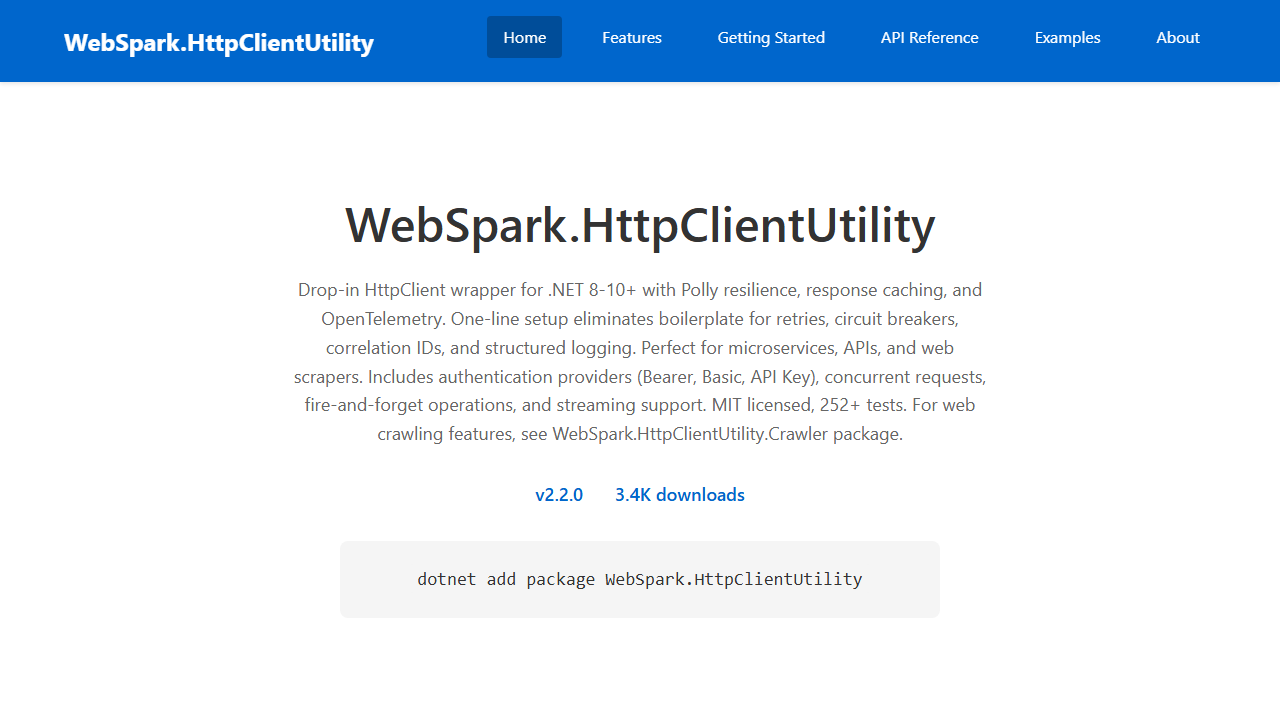
WebSpark.HttpClientUtility
WebSpark.HttpClientUtility is a drop-in HttpClient wrapper for .NET 8-10+ with Polly resilience (retries, circuit breakers), response caching, correlation IDs, and OpenTelemetry tracing — configured in one AddHttpClientUtility() call. Includes a separate Crawler package for web scraping. hundreds of passing unit tests.
Thousands of NuGet downloads

KeyPressCounter
Lightweight Windows system tray utility monitoring keyboard and mouse input activity alongside real-time system performance metrics and usage statistics.
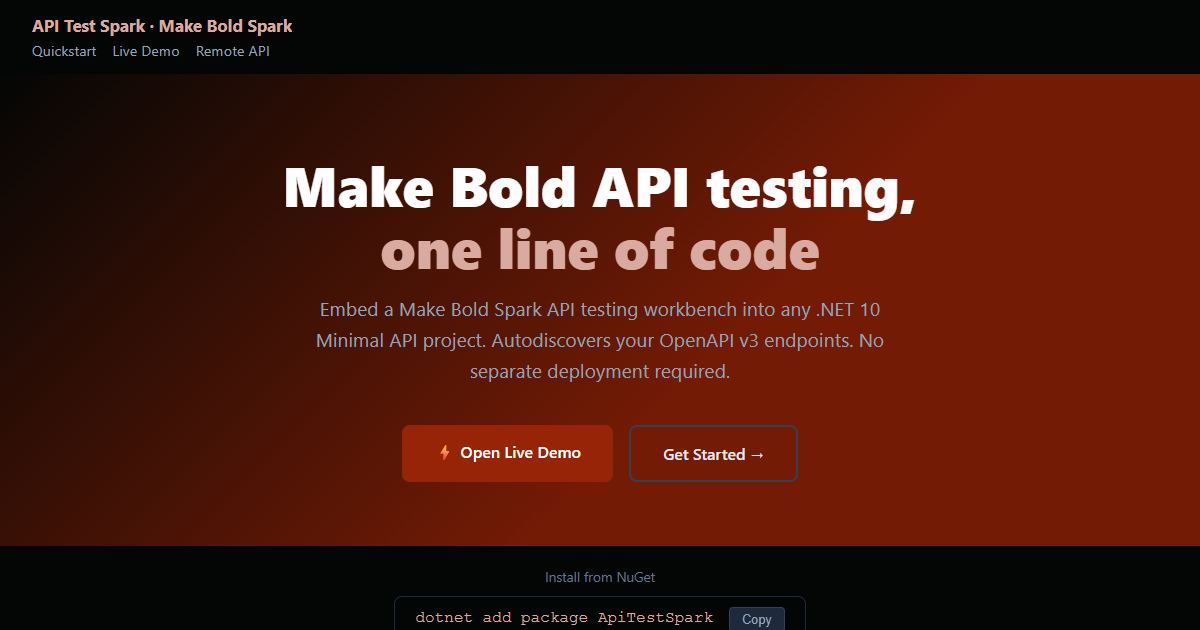
API Test Spark
A NuGet package that embeds an interactive API test harness into any .NET 10 Minimal API with one line of code. It reads the API's own OpenAPI contract, so there is nothing extra to keep in sync.
Thousands of NuGet downloads
Working through something similar?
If this maps to something you're working on, I'm glad to compare notes. Start with the system and the constraint that matters most.