Building Resilient .NET Applications with Polly
Network communication is inherently unreliable — timeouts, transient faults, downstream services that hiccup at exactly the wrong moment. Polly with HttpClient turns retries, timeouts, and circuit breakers from one-off code into a composable resilience pattern.
Development Series — 24 articles
- Decorator Design Pattern - Adding Telemetry to HttpClient
- NuGet Packages: Benefits and Challenges
- Mastering Git Repository Organization
- CancellationToken for Async Programming
- Git Flow Rethink: When Process Stops Paying Rent
- Understanding System Cache: A Comprehensive Guide
- Guide to Redis Local Instance Setup
- Creating a PHP Website with ChatGPT
- TaskListProcessor - Enterprise Async Orchestration for .NET
- Harnessing the Power of Caching in ASP.NET
- Fire and Forget for Enhanced Performance
- Building Resilient .NET Applications with Polly
- The Singleton Advantage: Managing Configurations in .NET
- Troubleshooting and Rebuilding My JS-Dev-Env Project
- Generate Wiki Documentation from Your Code Repository
- My Journey as a NuGet Gallery Developer and Educator
- Architecting Agentic Services in .NET 9: Semantic Kernel
- The Building of React-native-web-start
- TailwindSpark: Ignite Your Web Development
- Evolving PHP Development
- Modernizing Client Libraries in a .NET 4.8 Framework Application
- Building Git Spark: My First npm Package Journey
- Dave's Top Ten: Git Stats You Should Never Track
- Getting to Know Your Repository with git-spark
Filed under Pragmatic architecture and modernization
Topic cluster
Software Development Patterns.NET development, API integration, implementation patterns, and the trade-offs that show up in working code.
Master fault tolerance and resilience patterns in .NET development
Explore how Polly and HttpClient in .NET can be used together to create resilient applications. Learn to handle retries, timeouts, and transient faults effectively with practical examples and comprehensive explanations.
Source Code Repository
The full source code for the Async Demo Application is available on GitHub. This repository contains comprehensive examples demonstrating resilience patterns with Polly.
Polly + .NET
Building fault-tolerant applications
Introduction
Modern .NET HTTP Challenges
In modern .NET applications, making HTTP calls to remote services is a common task. However, network instability, transient errors, and service timeouts are challenges that developers must handle effectively.
This article provides a comprehensive guide on how to use Polly, a .NET resilience and transient-fault-handling library, in combination with CancellationToken to enhance the robustness of your HTTP calls with HttpClient. We'll walk through practical examples and explain the concepts in detail.
What Does Resilient Mean in a Web Application?
Resilience Definition
Resilience in the context of a web application refers to the ability of the application to maintain acceptable service levels despite facing various challenges, such as faults, failures, or unexpected loads. A resilient web application is designed to handle disruptions gracefully, recover quickly, and continue providing reliable service to users.
In modern web development, resilience is crucial because web applications often rely on multiple external services, APIs, and infrastructure components. These dependencies can introduce potential points of failure that, if not handled properly, can degrade the user experience or even cause the application to become unavailable.
Examples of Resilience in Web Applications
Here are some key aspects of resilience in web applications, along with examples of how they can be implemented:
Handling Transient Faults
Transient faults are temporary issues, such as network timeouts, that can resolve themselves if the operation is retried. A resilient application detects these faults and automatically retries the failed operation instead of immediately returning an error to the user.
For example, suppose your web application relies on an external API to fetch data. If the API request fails due to a network glitch, a resilient application would use a retry policy (such as one provided by Polly) to retry the request after a brief delay, improving the chances of success without requiring user intervention.
Implementing Circuit Breakers
A circuit breaker pattern is another important concept in building resilient applications. It prevents an application from repeatedly trying to perform an operation that is likely to fail, thereby protecting the application from overloading itself or the external service.
For instance, if a third-party service your application depends on becomes unresponsive, the circuit breaker can detect the repeated failures and temporarily stop sending requests to the service. During this "open" state, the application can return a fallback response to users, or it can serve cached data until the service becomes responsive again.
Graceful Degradation
Graceful degradation is the practice of designing an application to continue functioning in a reduced capacity if a part of it fails. This ensures that users can still perform essential tasks, even if some features are temporarily unavailable.
Consider an e-commerce website that relies on multiple microservices: one for user authentication, another for payment processing, and yet another for product recommendations. If the product recommendation service becomes unavailable, a resilient application would still allow users to browse products and complete purchases, but without personalized recommendations.
Rate Limiting and Throttling
Resilience also involves protecting your application from being overwhelmed by excessive requests, whether intentional (such as a DDoS attack) or unintentional (such as a sudden surge in traffic). Rate limiting and throttling are techniques used to control the number of requests your application processes over a specific period.
For example, if your web application provides an API for public use, you can implement rate limiting to ensure that no single client can overwhelm your servers with too many requests in a short time. This helps maintain service availability for all users, even during traffic spikes.
Timeout Management
In a distributed system, it's common to interact with external services that may be slow to respond or may not respond at all. To prevent your application from hanging indefinitely, it's important to implement timeouts that define how long your application should wait for a response before considering the operation a failure.
For instance, when making an HTTP request to an external API, setting a timeout ensures that your application can fail fast and handle the situation appropriately, such as by retrying the request, returning a cached response, or notifying the user of the delay.
Health Monitoring and Self-Healing
Resilient applications continuously monitor their own health and the health of their dependencies. When an issue is detected, the application can take corrective actions, such as restarting a failed service or rerouting traffic to a healthy instance.
An example of this is a cloud-based web application that uses auto-scaling to maintain performance during traffic spikes. If one server instance becomes unresponsive, the application can automatically spin up a new instance and redirect traffic, ensuring that users experience minimal disruption.
Key Resilience Principles
By incorporating resilience strategies, web applications can better withstand the challenges of real-world operation, such as network failures, service outages, and unexpected traffic surges. A resilient web application not only improves user satisfaction by minimizing downtime and disruptions but also enhances the overall reliability and robustness of the system.
Understanding HttpClient
.NET HttpClient Overview
The HttpClient class in .NET is a powerful tool for sending HTTP requests and receiving HTTP responses from a resource identified by a URI. It is often used for accessing RESTful services.
HttpClient is designed to be reusable and thread-safe. To avoid socket exhaustion, it's recommended to instantiate HttpClient once and reuse it throughout the application lifecycle.
Resources
Understanding Polly
Polly Resilience Library
Polly is a .NET library that provides resilience and transient-fault-handling capabilities. It allows you to define policies such as retries, circuit breakers, and timeouts for your operations, making your application more resilient to transient errors.
In this guide, we will focus on the Retry policy, which allows you to retry an operation in case of failure, with customizable retry logic including exponential backoff and jitter (random delay).
Resources
Using CancellationToken
Graceful Operation Cancellation
A CancellationToken is a struct in .NET that propagates notifications that operations should be canceled. It's used to gracefully stop operations that are taking too long or when a user or system requests a cancellation.
CancellationTokenSource is used to create a CancellationToken and can signal the token to cancel the associated operation.
Resources
Implementation Examples
MockResults Class Implementation
The MockResults class represents the outcome of a mock operation, including the loop count, maximum time allowed, actual runtime, and any return messages or values. It is used to encapsulate the input parameters and results of a mock operation, demonstrating long-running tasks with timeout handling.
public class MockResults
{
  public int LoopCount { get; set; }
  public string? ResultValue { get; set; } = "empty";
}
RemoteController Class Implementation
The RemoteController class simulates a remote API service that performs a long-running task. This controller demonstrates how to integrate CancellationToken into your operations to handle cancellations gracefully.
public class RemoteController : BaseApiController
{
  private async Task<MockResults> MockResultsAsync(int loopCount, CancellationToken cancellationToken)
  {
    var returnMock = new MockResults(loopCount, 0);
    try
    {
      var result = await _asyncMock.LongRunningOperationWithCancellationTokenAsync(loopCount, cancellationToken);
      returnMock.Message = "Task Complete";
      returnMock.ResultValue = result.ToString();
    }
    catch (TaskCanceledException)
    {
      throw;
    }
    catch (Exception ex)
    {
      returnMock.Message = quot;Error: {ex.Message}";
      returnMock.ResultValue = "-1";
    }
    return returnMock;
  }

  [HttpPost]
  [Route("Results")]
  public async Task<IActionResult> GetResults(MockResults model)
  {
    var cts = new CancellationTokenSource(TimeSpan.FromMilliseconds(model.MaxTimeMS));
    var watch = Stopwatch.StartNew();
    MockResults? result;
    try
    {
      result = await MockResultsAsync(model.LoopCount, cts.Token);
      result.MaxTimeMS = model.MaxTimeMS;
    }
    catch (OperationCanceledException)
    {
      watch.Stop();
      result = new MockResults(model.LoopCount, model.MaxTimeMS)
      {
        RunTimeMS = watch.ElapsedMilliseconds,
        Message = "Time Out Occurred",
        ResultValue = "-1"
      };
      return StatusCode((int)HttpStatusCode.RequestTimeout, result);
    }
    catch (Exception ex)
    {
      watch.Stop();
      result = new MockResults(model.LoopCount, model.MaxTimeMS)
      {
        RunTimeMS = watch.ElapsedMilliseconds,
        Message = quot;Error: {ex.Message}",
        ResultValue = "-1"
      };
      return StatusCode((int)HttpStatusCode.InternalServerError, result);
    }
    watch.Stop();
    result.RunTimeMS = watch.ElapsedMilliseconds;
    return Ok(result);
  }
}
PollyController with Retry Logic
The PollyController class demonstrates how to use Polly to implement retry logic with exponential backoff when making HTTP requests using HttpClient. Polly's retry policy is configured to handle transient errors, making the operation more resilient.
public class PollyController : Controller
{
  private readonly AsyncRetryPolicy<HttpResponseMessage> _httpIndexPolicy;
  private readonly HttpClient _httpClient;

  public PollyController(ILogger<PollyController> logger, IHttpClientFactory clientFactory)
  {
    _httpClient = clientFactory.CreateClient();
    _httpClient.DefaultRequestHeaders.Accept.Add(new MediaTypeWithQualityHeaderValue("application/json"));
    _httpIndexPolicy = Policy.HandleResult<HttpResponseMessage>(r => !r.IsSuccessStatusCode)
      .WaitAndRetryAsync(3,
        retryAttempt => TimeSpan.FromSeconds(Math.Pow(1, retryAttempt) / 2) + TimeSpan.FromSeconds(new Random().Next(0, 1)),
        onRetry: (response, timespan, retryCount, context) =>
        {
          context["retrycount"] = retryCount;
          logger.LogWarning(quot;Retry {retryCount}: Waiting {timespan} before next attempt.");
        });
  }

  [HttpGet]
  public async Task<IActionResult> Index(int loopCount = 1, int maxTimeMs = 1000)
  {
    var mockResults = new MockResults { LoopCount = loopCount, MaxTimeMS = maxTimeMs };
    var context = new Context { { "retrycount", 0 } };
    HttpResponseMessage response = await _httpIndexPolicy.ExecuteAsync(ctx =>
      HttpClientJsonExtensions.PostAsJsonAsync(_httpClient, "remote/Results", mockResults), context);
    return View("Index", mockResults);
  }
}
Conclusion
This guide has demonstrated how to build resilient HTTP clients in .NET using Polly and CancellationToken. By implementing these patterns, you can ensure that your applications handle transient errors gracefully, respond to timeouts, and maintain robust communication with remote services, even under adverse conditions.
Key Takeaways
Combining Polly's resilience policies with proper timeout management and cancellation tokens creates robust applications that can handle the unpredictable nature of distributed systems. These patterns are essential for building production-ready .NET applications that provide reliable user experiences.
Start implementing these resilience patterns in your .NET applications today to improve their reliability and user experience. The investment in fault tolerance will pay dividends in reduced support issues and improved application stability.
Explore More
- Decorator Design Pattern - Adding Telemetry to HttpClient -- Adding Telemetry to HttpClient in ASP.NET Core
- RESTRunner: Building a DIY API Load Testing Tool -- Conventional wisdom says never build your own load tester. Here are the three rules for when to break that — and four years of proof that they hold.
- NuGet Packages: Benefits and Challenges -- Exploring the Pros and Cons of NuGet Packages
- Mastering Git Repository Organization -- Enhance Collaboration and Project Management with Git
- Guide to Redis Local Instance Setup -- Master the Setup of Redis on Your Local Machine
Related project evidence
WebSpark.HttpClientUtility
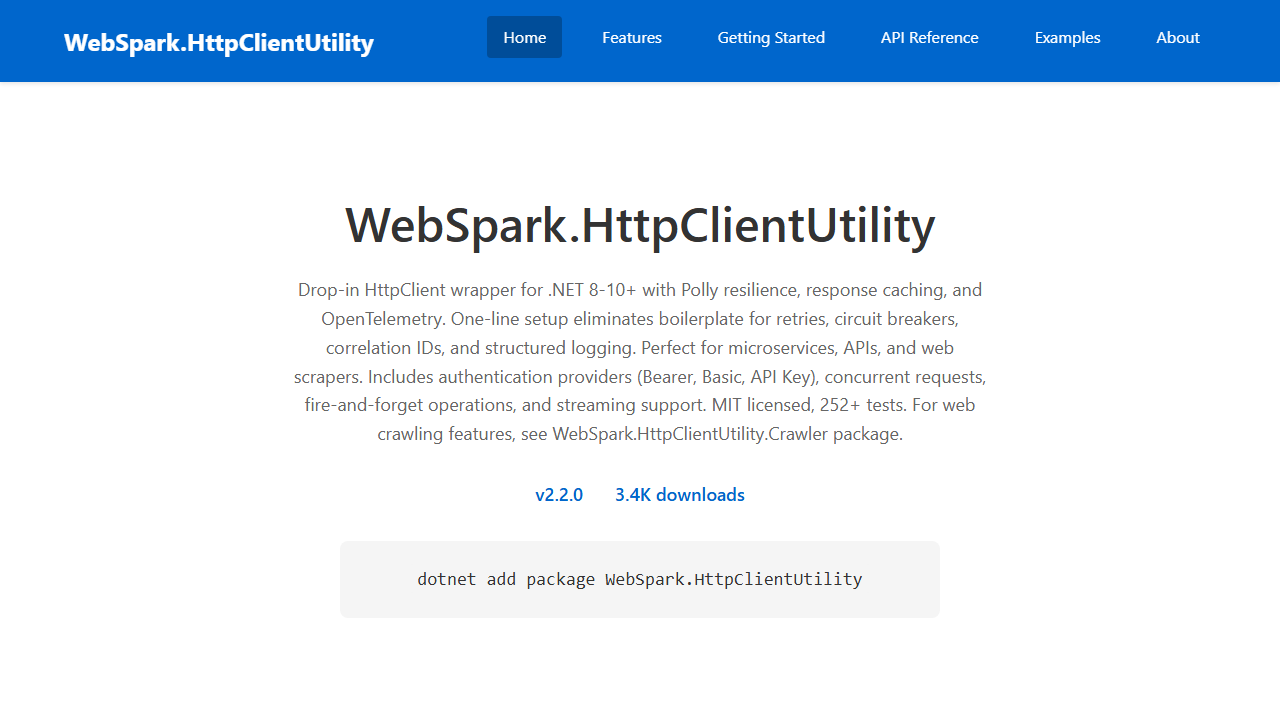
WebSpark.HttpClientUtility is a drop-in HttpClient wrapper for .NET 8-10+ with Polly resilience (retries, circuit breakers), response caching, correlation IDs, and OpenTelemetry tracing — configured in one AddHttpClientUtility() call. Includes a separate Crawler package for web scraping. hundreds of passing unit tests.
Thousands of NuGet downloads

UISampleSpark: Seven UI Paradigms, One Backend
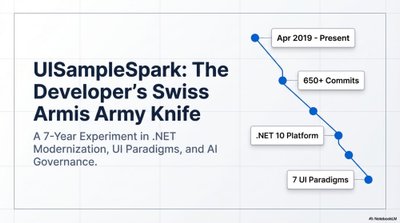
UISampleSpark compares multiple frontend approaches — MVC, Razor Pages, jQuery AJAX, React, Vue, htmx, Blazor, and SPA — all running against the same .NET 10 REST API. Originally a simple MVC CRUD demo, it has evolved into a living reference for modern UI architecture decisions with Docker containerization and Bootswatch theming.
API Test Spark
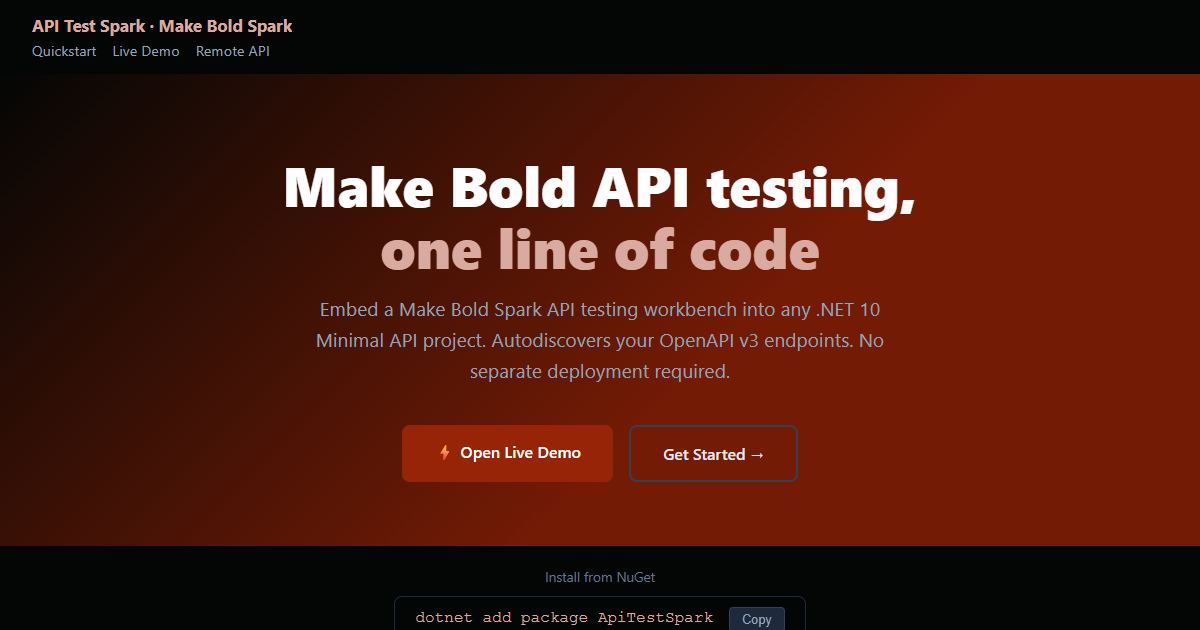
A NuGet package that embeds an interactive API test harness into any .NET 10 Minimal API with one line of code. It reads the API's own OpenAPI contract, so there is nothing extra to keep in sync.
Thousands of NuGet downloads
Working through something similar?
If this maps to something you're working on, I'm glad to compare notes. Start with the system and the constraint that matters most.