The Impact of Input Case on LLM Categorization
Large Language Models (LLMs) are sensitive to the case of input text, affecting their tokenization and categorization capabilities. This article delves into how input case impacts LLM performance, particularly in NLP tasks like Named Entity Recognition and Sentiment Analysis, and discusses strategies to enhance model robustness.
AI & Machine Learning Series — 28 articles
- Using ChatGPT for C# Development
- Trivia Spark: Building a Trivia App with ChatGPT
- Mastering LLM Prompt Engineering
- Building a Key Press Counter with ChatGPT
- ChatGPT Meets Jeopardy: C# Solution for Trivia Aficionados
- English: The New Programming Language of Choice
- Using Large Language Models to Generate Structured Data
- Prompt Spark: Revolutionizing LLM System Prompt Management
- Integrating Chat Completion into Prompt Spark
- WebSpark: Transforming Web Project Mechanics
- Accelerate Azure DevOps Wiki Writing
- The Brain Behind JShow Trivia Demo
- Interactive Chat in PromptSpark With SignalR
- Building Real-Time Chat with React and SignalR
- Workflow-Driven Chat Applications Powered by Adaptive Cards
- Understanding Neural Networks
- Creating a Law & Order Episode Generator
- The Transformative Power of MCP
- Computer Vision in Machine Learning
- Harnessing NLP: Concepts and Real-World Impact
- The Impact of Input Case on LLM Categorization
- The New Era of Individual Agency: How AI Tools Empower Self-Starters
- AI Observability Is No Joke
- Mountains of Misunderstanding: The AI Confidence Trap
- Measuring AI's Contribution to Code
- Building MuseumSpark - Why Context Matters More Than the Latest LLM
- Ithaka Gave You the Journey: AI-Assisted Development
- The Same Trick, Different Magic
Filed under Building software with AI
Topic cluster
AI and Machine LearningApplied AI, machine learning, and the practical limits of intelligent systems.
The Impact of Input Case on LLM Categorization
How Case Sensitivity Affects Tokenization and Categorization in NLP
Large Language Models (LLMs) have demonstrated remarkable capabilities in various Natural Language Processing (NLP) tasks, including text categorization. However, the seemingly minor detail of input case can significantly influence how these models process information, leading to variations in tokenization and, consequently, the categories they return. Understanding this sensitivity is crucial for developing robust and reliable categorization agents.
Machine Learning
Deep dive into LLM tokenization and case sensitivity
Deep Dive: LLM Prompt Case Sensitivity
Unlock the secrets of LLM prompt case sensitivity! This deep dive explores how the seemingly simple act of capitalization in your AI prompts can drastically impact the responses you receive from Large Language Models (LLMs). Discover why case sensitivity matters in prompt engineering, affecting tasks like sentiment analysis where emphasis can be key, and topic classification where proper nouns and acronyms are crucial. Learn best practices for case-specific prompt engineering to enhance the accuracy and clarity of your AI interactions and avoid unexpected results. Whether you're a beginner or an experienced prompt engineer, understanding LLM response variations based on prompt case is essential for maximizing AI utility.
Video: Deep Dive on LLM Prompt Case Sensitivity – Learn how input case impacts tokenization, categorization, and prompt engineering for NLP and LLMs.
Tokenization: The First Hurdle Influenced by Case
At the core of how LLMs understand text lies tokenization, the process of breaking down raw text into smaller units called tokens. Tokenization, the process of breaking text into tokens, is profoundly impacted by input case. Case-sensitive tokenizers treat "Apple" and "apple" as distinct, while case-insensitive tokenizers merge them, affecting downstream tasks. The way an LLM's tokenizer handles case sensitivity plays a pivotal role in shaping the input it ultimately processes.
Case-Sensitive Tokenization
Many LLMs utilize case-sensitive tokenizers, where uppercase and lowercase forms of a word are treated as distinct tokens. For instance, in a case-sensitive model, "Apple" and "apple" would be assigned different token IDs and embedding vectors. This distinction allows the model to potentially capture nuances associated with capitalization, such as proper nouns or emphasis.
Case-Insensitive Tokenization
Some approaches employ case-insensitive tokenization, typically by converting all input text to lowercase before tokenization. In such systems, "Apple" and "apple" would be treated as identical tokens. While this simplifies the vocabulary and can aid generalization in some tasks, it also means the loss of any information conveyed through capitalization.
Subword Tokenization Complexity
Subword tokenizers like BERT's WordPiece can split "AIRPORT" into fragments (e.g., "AI", "##R"), complicating categorization compared to "airport" as a single token. The choice of tokenization directly dictates the sequence of tokens the LLM receives as input. Therefore, altering the case in the input can fundamentally change the representation the model uses for categorization.
Furthermore, case changes can affect how subword tokenizers split words. For example, a word like "airport" might be a single token for BERT's WordPiece tokenizer. However, if the input is "AIRPORT" (all caps), it could be broken down into multiple subword fragments like "AI", "##R", "##PO", "##RT". This fragmentation of all-caps words into "nonsense" subword pieces can complicate the model's understanding and potentially lead to different categorization outcomes
How Tokenization Changes Impact Categorization
Tokenization changes ripple through LLM layers, altering internal representations and leading to different classification outputs. Models may activate different learned patterns based on input case. Since tokenization is the initial step in processing text for an LLM, any changes at this stage propagate through the model's layers, ultimately influencing the categorization output.
Impact on Model Representation
If the input case alters the tokens, the model's internal representation of the text will be different. This means the model might activate different patterns and associations learned during its training, potentially leading to different classification decisions.
Case Sensitivity Across Different LLM Architectures
Case sensitivity varies across models like BERT, GPT, and others:
BERT Cased vs. Uncased
BERT-base-cased preserves capitalization, aiding tasks like NER, while BERT-base-uncased generalizes better by ignoring case. The uncased version was trained on lowercased text, making it inherently case-insensitive. In contrast, the cased version preserves the original casing and can leverage capitalization cues. This design choice leads to performance differences on various tasks. For instance, BERT-base-cased might perform better on Named Entity Recognition where capitalization is crucial, while BERT-base-uncased might generalize better for topic classification where the underlying meaning is less dependent on case.
GPT and Decoder Models
GPT models (e.g., GPT-2, GPT-3) use case-sensitive BPE tokenization, yet show robustness to noisy input due to their training data scale. Models in the GPT family utilize byte-pair encoding (BPE) tokenization without lowercasing, making them inherently case-sensitive. They assign different token IDs even for the same word with different casing (e.g., "Hello" vs. "hello"). Despite this sensitivity, research suggests that decoder-only LLMs like GPT-2 can be relatively robust to noisy case changes, potentially due to their extensive training data and byte-level BPE handling variations smoothly.
Other Transformers
Many modern Transformers (RoBERTa, XLNet, T5) retain case information by default, impacting their categorization behaviors depending on the task. They typically retain case by default through subword tokenization or byte encodings. However, older models or those explicitly trained with case normalization (like some LSTM-based classifiers) will be case-insensitive.
Impact on Specific Categorization Tasks
Sentiment Analysis
Casing enhances sentiment detection by preserving cues like all-caps emphasis (e.g., "AMAZING!"). While the core sentiment often resides in the words themselves, casing can carry subtle sentiment cues. For example, all-caps words like "AMAZING!" can indicate intensified emotion. Lowercasing everything would lose this emphasis.
Some sentiment analysis systems even explicitly boost sentiment intensity for all-caps words. Therefore, preserving case might be beneficial for sentiment classifiers to capture these nuances. However, one must also be aware that uncommon all-caps words might be split into subwords, which the model then needs to interpret.
Topic Classification
Case sensitivity helps identify acronyms and proper nouns ("WHO" vs. "who"), critical in topic categorization. Historically, making models case-insensitive was often considered acceptable, or even helpful, for topic classification, as the difference between "inflation" and "Inflation" is usually insignificant for determining the topic.
However, case can be crucial for identifying domain-specific terms, acronyms, and proper nouns that are strong indicators of a topic (e.g., "COVID-19", "UNICEF", "Python" vs. "python"). A case-sensitive model can differentiate between "who" (a pronoun) and "WHO" (World Health Organization). Modern transformer models used for topic classification generally retain case and perform well.
Ensuring Robustness to Varying Input Case
Best Practices for Robust Models
- For robust agents, employ data augmentation with mixed-case samples
- Experiment with both cased and uncased preprocessing depending on task needs
- Use data augmentation with mixed-case examples during training
- Evaluate model performance with both original-cased and lowercased input
Ideally, a categorization agent should be robust to variations in user input case, including titles in all caps or random capitalization. If a model was primarily trained on well-cased text, it might misinterpret oddly cased input. Strategies to address this include data augmentation with mixed-case examples during training. For critical applications, it might be necessary to experiment with both case-sensitive and case-insensitive preprocessing or even use additional features to explicitly capture information lost through normalization.
Conclusion
Key Findings
Input case significantly impacts LLM categorization agents by influencing the tokenization process. Case-sensitive tokenization preserves potential nuances but can lead to different tokens for the same word with different casing, potentially altering the model's internal representation and categorization output.
Different LLM architectures exhibit varying degrees of case sensitivity based on their tokenizers and training.
Practical Implications
The importance of preserving case depends on the specific categorization task; it can be beneficial for capturing sentiment intensity and distinguishing topic-defining acronyms and proper nouns, but might be less critical for general topic identification.
Final Recommendations
Ultimately, understanding your model's tokenizer, the role of case in your specific categorization task, and experimenting with different preprocessing approaches are key to building reliable and robust LLM-based categorization agents. Evaluating your model's performance with both original-cased and lowercased input can reveal its sensitivity to case changes and guide you in making informed decisions about text preprocessing.
Glossary of Key Terms
Large Language Model (LLM)
A Large Language Model (LLM) is a type of artificial intelligence model trained on vast amounts of text data to understand, generate, and manipulate human language. These models use deep learning techniques, particularly transformer architectures, to capture complex patterns and relationships in language, enabling them to perform a wide range of tasks such as translation, summarization, question answering, and text generation.
LLMs have revolutionized the field of natural language processing by achieving state-of-the-art results on many benchmarks. Their ability to generalize from massive datasets allows them to handle nuanced language tasks, but they also require significant computational resources for training and inference. See more on Wikipedia
Tokenization
Tokenization is the process of breaking text into smaller units called tokens, which are the basic building blocks for language models. Tokens can be words, subwords, or even individual characters, depending on the tokenizer's design and the language being processed.
Effective tokenization is crucial for language models because it determines how text is represented and understood by the model. The choice of tokenization method can impact model performance, vocabulary size, and the ability to handle rare or unknown words. See more on Wikipedia
Natural Language Processing (NLP)
Natural Language Processing (NLP) is a field of artificial intelligence focused on enabling computers to understand, interpret, and generate human language. NLP combines computational linguistics, machine learning, and deep learning to process and analyze large amounts of natural language data.
Applications of NLP include machine translation, sentiment analysis, chatbots, speech recognition, and information extraction. NLP is foundational to many modern AI systems, allowing them to interact with users in a more natural and intuitive way. See more on Wikipedia
BERT
BERT (Bidirectional Encoder Representations from Transformers) is a transformer-based language model developed by Google that introduced bidirectional context into language modeling. Unlike previous models that read text sequentially, BERT reads text in both directions, allowing it to better understand the context of each word.
BERT has set new standards in NLP by achieving top performance on a variety of tasks, including question answering and named entity recognition. Its architecture has inspired many subsequent models and is widely used in both research and industry. See more on Wikipedia
GPT
GPT (Generative Pre-trained Transformer) is a family of large language models developed by OpenAI. These models are trained on massive datasets using unsupervised learning, enabling them to generate coherent and contextually relevant text based on a given prompt.
GPT models have been widely adopted for tasks such as text completion, conversation, and creative writing. Their autoregressive nature allows them to predict the next word in a sequence, making them highly effective for generative tasks. See more on Wikipedia
Token
A token is a unit of text, such as a word, part of a word, or character, that serves as input for language models. The definition of a token can vary depending on the tokenizer and the language being processed.
Tokens are essential for converting raw text into a format that can be processed by machine learning models. The way text is tokenized can influence model accuracy, efficiency, and the ability to handle new or rare words. See more on Wikipedia
Embedding
An embedding is a numerical representation of a token or word in a vector space, used by language models to capture semantic meaning and relationships between words. Embeddings allow models to perform mathematical operations on language, such as measuring similarity or analogy.
High-quality embeddings are crucial for effective language understanding, as they enable models to generalize across different contexts and tasks. Techniques like Word2Vec, GloVe, and transformer-based embeddings have advanced the field significantly. See more on Wikipedia
Subword Tokenization
Subword tokenization is a technique that splits words into smaller units, or subwords, to improve the handling of rare or unknown words. This approach helps language models manage large vocabularies and better represent complex or compound words.
Methods like Byte Pair Encoding (BPE) and WordPiece are commonly used for subword tokenization. These methods allow models to break down unfamiliar words into known components, enhancing their ability to process diverse language inputs. See more on Wikipedia
Named Entity Recognition (NER)
Named Entity Recognition (NER) is an NLP task that identifies and classifies named entities—such as people, organizations, locations, and dates—in text. NER is essential for extracting structured information from unstructured data.
NER systems are widely used in applications like information retrieval, question answering, and content recommendation. Accurate NER improves the ability of AI systems to understand and organize large volumes of textual information. See more on Wikipedia
Transformer
A transformer is a neural network architecture that uses self-attention mechanisms to process input data in parallel, rather than sequentially. This design enables transformers to capture long-range dependencies and relationships in language more effectively than previous models.
Transformers have become the foundation of most modern language models, including BERT and GPT, due to their scalability and superior performance on a wide range of NLP tasks. See more on Wikipedia
Explore More
- Harnessing NLP: Concepts and Real-World Impact -- From Foundational Concepts to Industry-Changing Applications
- Using ChatGPT for C# Development -- Accelerate Your Coding with AI
- Trivia Spark: Building a Trivia App with ChatGPT -- Rapid Prototyping and AI-Assisted Development in Practice
- Mastering LLM Prompt Engineering -- The Art of Effective AI Communication
- ChatGPT Meets Jeopardy: C# Solution for Trivia Aficionados -- Blending Trivia and Technology
Related project evidence

Git Spark: Advanced Git Repository Analytics Tool
Git Spark is an npm CLI tool and Node.js library that analyzes Git repository commit history to provide insights into contributor activity, code changes, and development patterns. Generates interactive HTML reports with charts, plus JSON, CSV, and Markdown exports.
Thousands of npm downloads
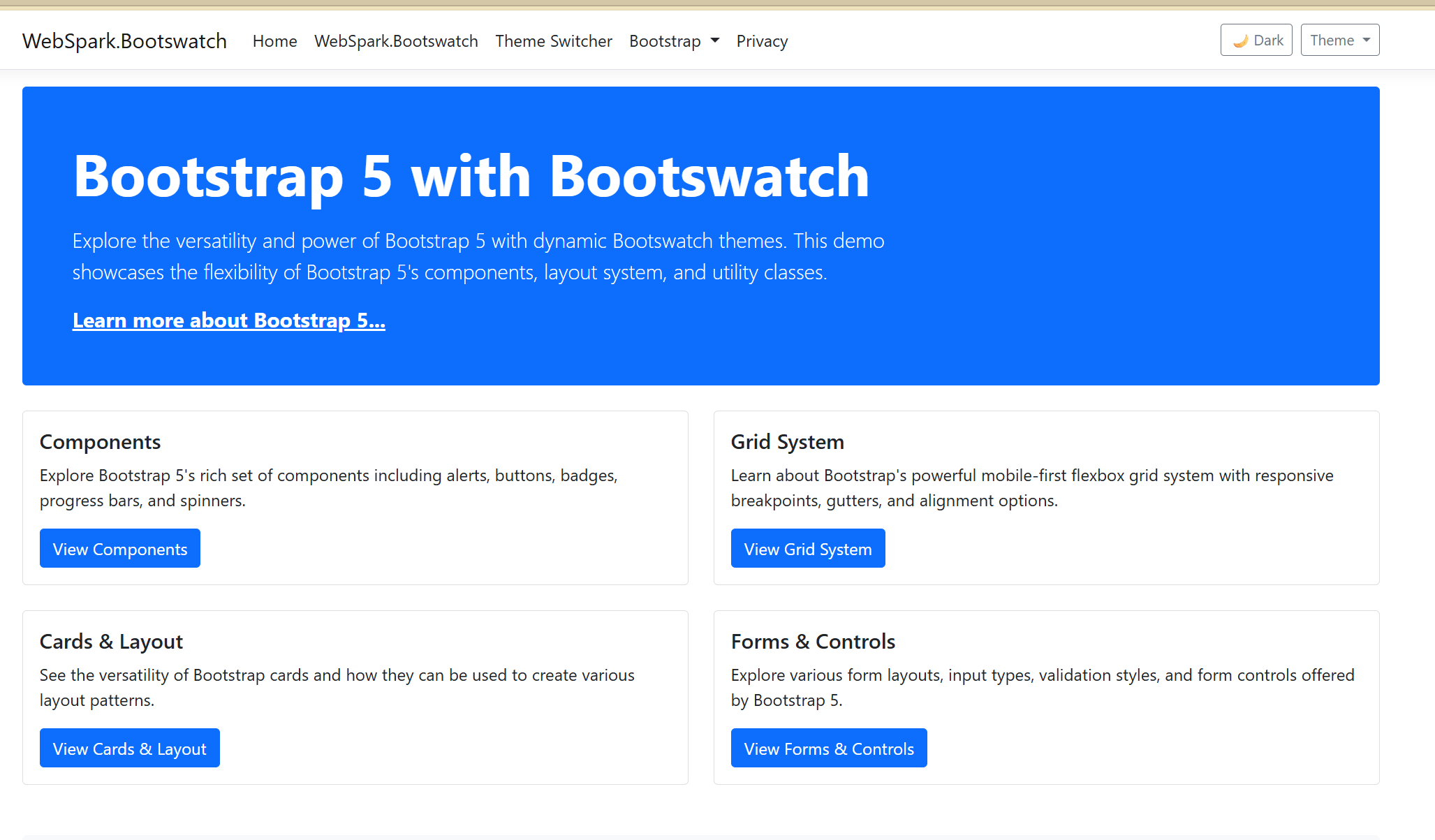
WebSpark Bootswatch Theme Integration Library
WebSpark.Bootswatch is a .NET Razor Class Library (NuGet package) enabling seamless Bootswatch theme integration into ASP.NET Core applications. Version 2.0+ targets .NET 10 exclusively, featuring dynamic theme switching, light/dark mode with auto-detection, tag helper support, and high-performance StyleCache caching.
Thousands of NuGet downloads
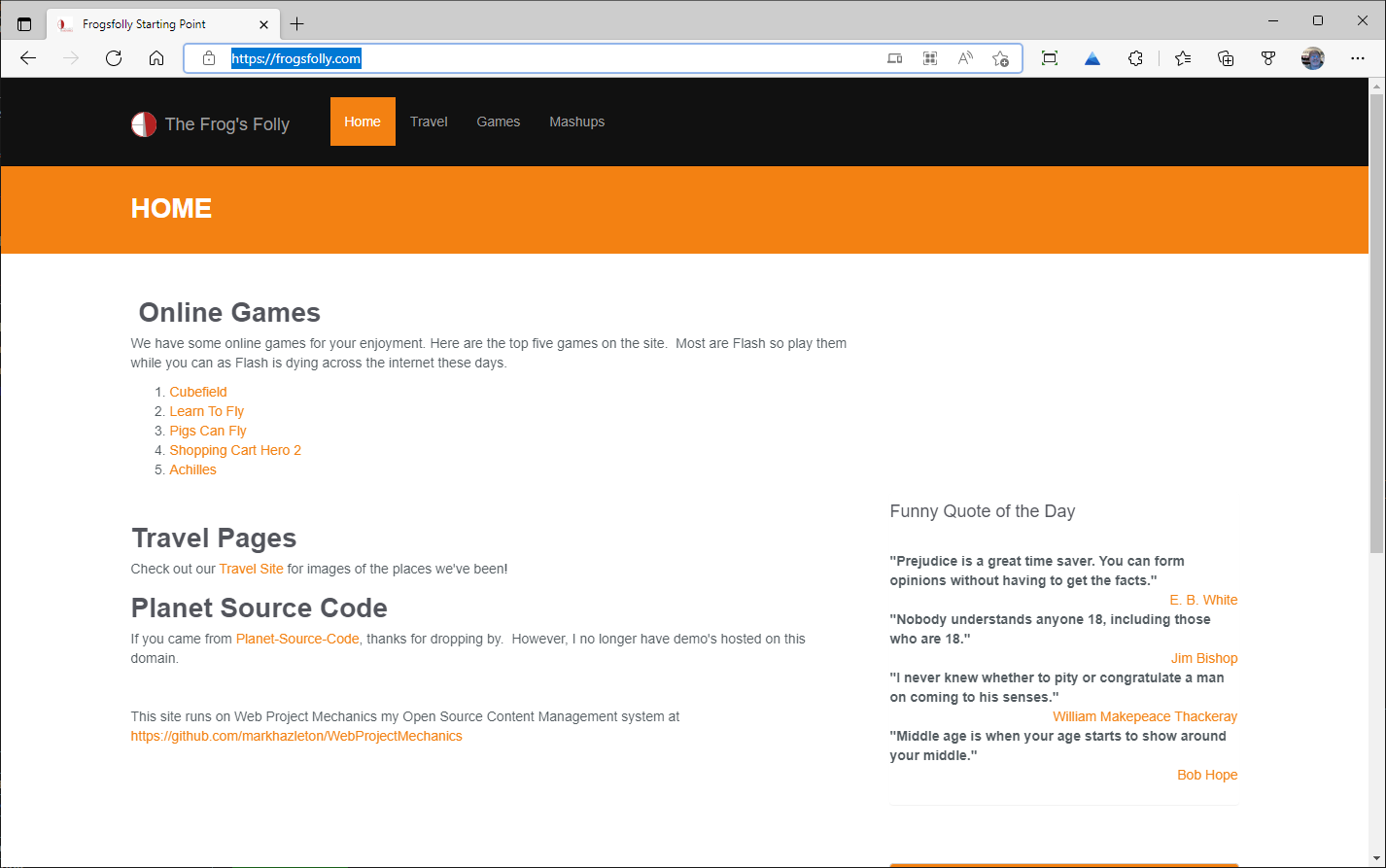
Frogsfolly.com Main
Frogsfolly.com is the original website I created in 1999 when learning web technologies.
Working through something similar?
If this maps to something you're working on, I'm glad to compare notes. Start with the system and the constraint that matters most.