The New Era of Individual Agency: How AI Tools Empower Self-Starters
AI tools have dramatically expanded what a self-starter can attempt — but capability isn't authority, and it isn't accountability. This article works through that distinction, what it means for the old excuse "I can't do this," and why AI makes both distributed search and distraction cheaper at the same time.
AI & Machine Learning Series — 27 articles
- Using ChatGPT for C# Development
- Trivia Spark: Building a Trivia App with ChatGPT
- Mastering LLM Prompt Engineering
- Building a Key Press Counter with ChatGPT
- ChatGPT Meets Jeopardy: C# Solution for Trivia Aficionados
- English: The New Programming Language of Choice
- Using Large Language Models to Generate Structured Data
- Prompt Spark: Revolutionizing LLM System Prompt Management
- Integrating Chat Completion into Prompt Spark
- WebSpark: Transforming Web Project Mechanics
- Accelerate Azure DevOps Wiki Writing
- The Brain Behind JShow Trivia Demo
- Interactive Chat in PromptSpark With SignalR
- Building Real-Time Chat with React and SignalR
- Workflow-Driven Chat Applications Powered by Adaptive Cards
- Understanding Neural Networks
- Creating a Law & Order Episode Generator
- The Transformative Power of MCP
- Computer Vision in Machine Learning
- Harnessing NLP: Concepts and Real-World Impact
- The Impact of Input Case on LLM Categorization
- The New Era of Individual Agency: How AI Tools Empower Self-Starters
- AI Observability Is No Joke
- Mountains of Misunderstanding: The AI Confidence Trap
- Measuring AI's Contribution to Code
- Building MuseumSpark - Why Context Matters More Than the Latest LLM
- Ithaka Gave You the Journey: AI-Assisted Development
Filed under Governed AI-assisted delivery
Topic cluster
AI and Machine LearningApplied AI, machine learning, and the practical limits of intelligent systems.
The New Era of Individual Agency: How AI Tools Are Empowering the Self-Starter
The New Era of Individual Agency: How AI Tools Change What Self-Starters Can Do
Introduction
I recently watched a non-designer use Canva to build a presentation in 20 minutes. The slide looked polished. But the information hierarchy buried the call-to-action entirely. Speed and polish masked a real mistake — and she shipped it anyway because the output looked finished. That tension is what AI democratization actually looks like in practice.
I've noticed self-starters treating AI tools like a shortcut to specialist work — and sometimes they're right. But I've also watched projects where the speed gain created new blind spots. The trade-off isn't always obvious, and it's rarely discussed honestly.
The Rise of AI Tools
AI tools have become increasingly accessible, offering a wide range of functionalities that accelerate productivity and open up creative work. From machine learning algorithms to natural language processing, these tools assist users across writing, design, data analysis, and workflow automation.
What I've found is that the tools themselves aren't the story. The story is what happens when someone who doesn't have a specialist's instincts picks one up and moves fast.
Democratizing Capabilities
On a recent project, I used Zapier to automate lead qualification for a client's sales workflow. The setup took about a week to get right. The payoff was real — we eliminated roughly four hours of manual triage per day. But it created a new failure mode I didn't anticipate: when the upstream API changed, nobody on the team understood the logic running under the hood. The automation kept firing, but it was routing leads incorrectly for three days before anyone noticed. The tool had hidden the dependency from the people who depended on it most.
That's what I've learned about democratization: it doesn't eliminate the need for specialist knowledge — it defers the cost of not having it. A self-starter can move fast and produce something that looks right. The gap shows up later, usually at the worst moment.
What Acceleration Actually Buys You
- Time on routine work: AI handles the repetitive layer — formatting, grammar passes, data joins — which genuinely frees up bandwidth for decisions that require judgment.
- Lower barrier to experimentation: When generating a first draft or a rough mockup costs minutes instead of hours, you run more experiments. Some of those experiments teach you something real.
- Access to analysis you'd otherwise skip: Data visualization tools surface patterns that would stay buried in a spreadsheet. In my experience, the value isn't in the chart — it's in the question the chart forces you to ask.
Capability isn't authority
There's a distinction I didn't have clean language for when I first wrote this article, and it's the most important thing I think AI has actually changed. I've written elsewhere about the difference between authority — what you're entitled to decide or change — and accountability — what you actually answer for when something goes wrong. AI touches neither of those directly. What it moves is a third thing: capability, what you're actually able to accomplish.
A developer with an AI coding agent may suddenly be capable of modifying production infrastructure, rewriting an authentication system, or changing a database schema in an afternoon. None of that grants the authority to make those changes, and none of it transfers the accountability if they go wrong. The tool expanded what's technically possible. It didn't touch who's allowed to decide, or who answers for the outcome.
That's worth sitting with, because it's easy to conflate the three. Capability feels like power, and power feels like it should come with the right to use it. It doesn't. The self-starters getting the most out of these tools aren't the ones treating expanded capability as expanded authority — they're the ones who know the difference and still ask before touching anything that isn't theirs to touch.
Where the boundary actually moved
I've also written about turtling — the pattern where someone hits a real blocker, understands it clearly, and quietly stops generating their own next move. One of turtling's oldest excuses was a genuine capability gap: I can't build the prototype, I don't have a designer. I can't analyze this dataset, I'm not a data person. I can't draft this, I'm not a writer.
Those excuses used to be true more often than not. AI has moved the boundary. Today, that same sentence is more often "I haven't yet attempted this using the tools available to me" than it is a real constraint. Not always — some gaps are still genuine, and the tools still fail in ways that matter — but the honest version of the excuse has gotten harder to find.
That doesn't mean AI dissolves every blocker, and I don't want to overstate it. What it does mean is that the line between a real constraint and a turtled one has shifted further toward the second category than it used to sit, which quietly raises the bar for what counts as a legitimate reason to stop looking.
AI gives the octopus longer arms
The same shift shows up in the Octopus Model of Agency — the idea that when one path fails, the move is to send another informed attempt after it instead of stopping. Before AI, sending another arm down a path had a real cost. A different architecture might take days to prototype. An unfamiliar domain might take hours of research before you knew enough to try anything useful. Writing out three alternative approaches to compare wasn't always practical inside a sprint.
AI collapses a lot of that cost. A rough mockup or a first draft that used to take an afternoon now takes minutes, which means more of those attempts are actually affordable to run. AI doesn't replace the Octopus Model. It gives the octopus longer arms — the same distributed search, with a wider radius and a lower cost per attempt.
Challenges and Considerations
That lower barrier has a cost, though, and it isn't the one people usually warn about. I've written about sizzle — the pull toward whatever looks impressive instead of whatever the problem actually needs. When the cost of an experiment approaches zero, the cost of a distraction approaches zero right along with it. AI makes it just as cheap to prototype something nobody asked for, rewrite something that wasn't broken, or chase five frameworks in an afternoon as it is to run a genuinely useful search. The tool can't tell the difference. Only the outcome you're actually working toward can tell you which one you're doing.
There's a second cost that's more familiar: democratization creates a specific kind of false confidence. A designer using Canva produces polished mockups in minutes but may not catch hierarchy problems that cost you on user testing. A writer using an AI content tool gets readable prose quickly but may miss that the tone is off-brand in ways that matter to a returning customer. The tool hides what you don't know — and it hides it behind an output that looks complete.
The bias problem in AI-generated outputs is real, but in my experience the more common failure mode is subtler: people stop asking whether the output is right because it looks right. That's a critical-thinking gap that the tools don't solve and can actually make worse — I've written about that erosion in more depth from the developer's side of the same problem.
It's worth applying the same discipline to AI agents that I'd want applied to myself. DevSpark's autonomy guardrails exist for exactly this reason: an agent's capability can outrun what it's earned the right to do just as easily as a person's can, and the fix in both cases is the same — track record before trust, not capability alone.
Conclusion
AI tools have changed what's possible for self-starters — that much is true. But I'd push back on any framing that treats that change as purely positive, or as a change to authority and accountability rather than to capability. What I've watched, across multiple projects, is that speed and accessibility shift the location of the risk, not the amount of it, and they shift the shape of the old excuses without touching who's actually responsible for what ships. The mistakes don't disappear; they move downstream, where they're harder to catch and more expensive to fix.
The self-starters who get the most out of these tools aren't the ones who move fastest. They're the ones who stay curious about what the tool is hiding from them, and honest about the difference between what they're now capable of and what's actually theirs to decide.
"The future belongs to those who stay skeptical enough to ask what the AI got wrong." - Mark Hazleton
Final Thoughts
As AI continues to evolve, the gap between what these tools can produce and what users understand about what they've produced will keep widening. In my experience, the most useful thing a self-starter can do isn't to adopt more tools — it's to build the habit of interrogating the output before shipping it, and the habit of asking whether a newly capable move is also an authorized one. That habit is harder to develop than it sounds when the output already looks finished.
For more insights on working with AI tools for personal and professional growth, visit Mark Hazleton's Blog.
Explore More
- Every Arm Is Still Searching: The Octopus Model of Agency — how AI lowers the cost of the distributed search this article describes
- Turtling: When a Team Stops Looking for the Door — where the boundary between a real constraint and a stopped search actually sits
- Sidetracked by Sizzle: Staying Focused on True Value — why cheaper experimentation makes cheap distraction just as easy to justify
- Accountability and Authority: Walking the Tightrope — the distinction this article borrows to separate capability from authority
- AI and Critical Thinking in Software Development — the same capability-versus-judgment gap, from the developer's side
- DevSpark: Autonomy Guardrails — the same discipline applied to AI agents instead of AI users: capability earns trust, it doesn't grant it
- Using ChatGPT for C# Development -- Accelerate Your Coding with AI
- Accelerate Azure DevOps Wiki Writing -- Enhance Your Documentation Process with Azure Wiki Expert GPT
- Trivia Spark: Building a Trivia App with ChatGPT -- Rapid Prototyping and AI-Assisted Development in Practice
- Mastering LLM Prompt Engineering -- The Art of Effective AI Communication
- ChatGPT Meets Jeopardy: C# Solution for Trivia Aficionados -- Blending Trivia and Technology
Related project evidence

DevSpark: Constitutional AI Governance Framework
DevSpark is a standalone AI-assisted development framework that extends Specification-Driven Development with constitution-based PR reviews, codebase-wide compliance auditing, adversarial risk analysis, brownfield constitution discovery, and adaptive lifecycle management. DevSpark makes project constitutions valuable throughout the entire development lifecycle — from greenfield planning through continuous constitutional governance.
Used across most of my active repositories, including this site

GitHub Stats Spark
Automated GitHub profile statistics generator with AI-powered repository analysis, SVG visualizations, and the pipeline that feeds live repository data to this site.
Powers the repository stats on this site
API Test Spark
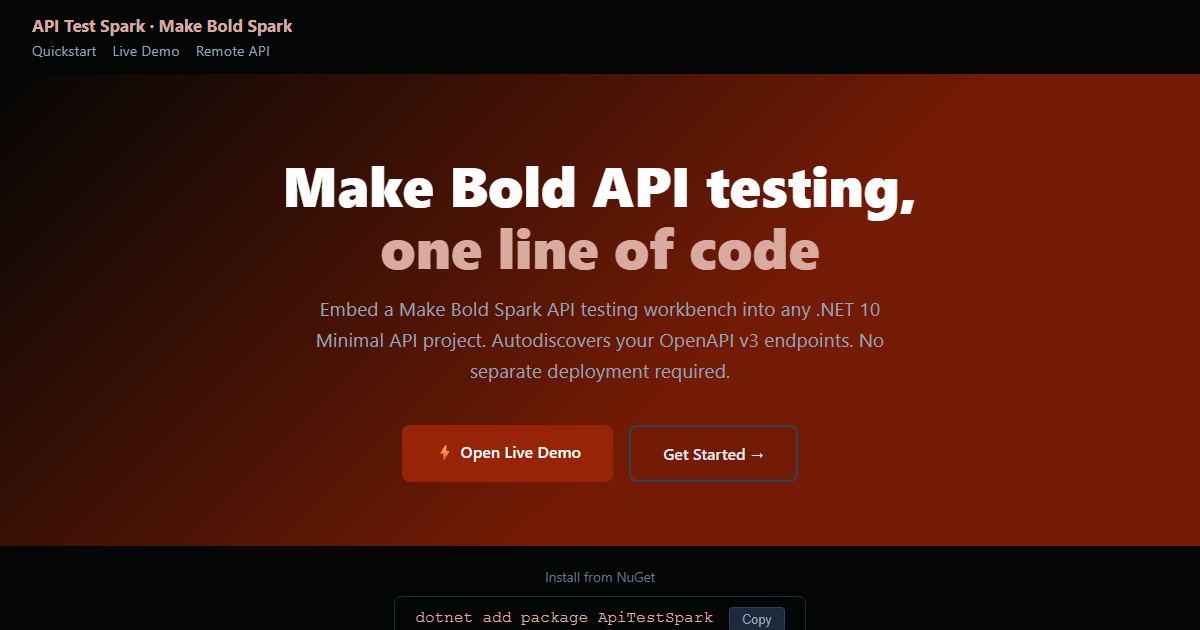
A NuGet package that embeds an interactive API test harness into any .NET 10 Minimal API with one line of code. It reads the API's own OpenAPI contract, so there is nothing extra to keep in sync.
Thousands of NuGet downloads
Working through something similar?
If this maps to something you're working on, I'm glad to compare notes. Start with the system and the constraint that matters most.