The Unexpected Roadmap: Imagination, AI, and Architecture
A forgotten psychologist’s name leads through positive disintegration, imagination, and AI-assisted development to a different view of software roadmaps. The destination may stay steady while the best path changes as experiments reveal what the product needs.
DevSpark Series — 35 articles
- Taking DevSpark to the Next Level
- From Oracle CASE to Spec-Driven AI Development
- Fork Management: Automating Upstream Integration
- Why I Built DevSpark
- Getting Started with DevSpark: Requirements Quality Matters
- DevSpark: Constitution-Based Pull Request Reviews
- DevSpark: The Evolution of AI-Assisted Software Development
- DevSpark: Months Later, Lessons Learned
- DevSpark in Practice: A NuGet Package Case Study
- DevSpark: From Fork to Framework — What the Commits Reveal
- DevSpark v0.1.0: Agent-Agnostic, Multi-User, and Built for Teams
- DevSpark Monorepo Support: Governing Multiple Apps in One Repository
- Bring Your Own AI: DevSpark Unlocks Multi-Agent Collaboration
- Dogfooding DevSpark: Building the Plane While Flying It
- DevSpark: Constitution-Driven AI for Software Development
- The DevSpark Tiered Prompt Model: Resolving Context at Scale
- Workflows as First-Class Artifacts: Defining Operations for AI
- Closing the Loop: Automating Feedback with Suggest-Improvement
- Observability in AI Workflows: Exposing the Black Box
- Autonomy Guardrails: Bounding Agent Action Safely
- Designing the DevSpark CLI UX: Commands vs Prompts
- A Governed Contribution Model for DevSpark Prompts
- The Alias Layer: Masking Complexity in Agent Invocations
- Prompt Metadata: Enforcing the DevSpark Constitution
- DevSpark Blogging Workflow: How I Built Better Articles
- DevSpark and Agent Skills: Beyond Portable AI Capabilities
- The Methodology Tax: Why Grassroots Innovation Gets Rejected
- DevSpark's Next Evolution: Rethinking Where Knowledge Lives
- DevSpark v4: The Spec Was Never the Record
- DevSpark: Change Must Start With a Real Need
- I'm Not a Game Developer. I Built a Game Anyway.
- QA Was Always My Last Battle Front
- DevSpark Dogfooding: Escaping the Scope-Creep Spiral
- DevSpark Roadmaps: Planning Before the Agent Builds
- The Unexpected Roadmap: Imagination, AI, and Architecture
Filed under Building software with AI
Topic cluster
DevSpark and Spec-Driven DeliverySpec-driven development, AI-assisted delivery workflows, governance, and the DevSpark toolkit.
I started with a question about something my daughter had studied in college. I ended up redesigning how I think about software roadmaps.
There was no plan to connect the two. I was trying to remember the name of a psychologist whose theories had come up in a conversation about gifted and talented education. I couldn’t remember his name. I certainly couldn’t spell it.
I typed Self discentegration dubrovsky into ChatGPT. Not exactly a promising beginning.
The Psychologist Whose Name I Couldn’t Spell
The name was Kazimierz Dąbrowski, a Polish psychologist known for his Theory of Positive Disintegration. His work has been influential in gifted education, particularly in discussions of emotional intensity and the internal conflicts that can accompany growth.
The idea that caught my attention was that growth sometimes requires the breakdown of an existing way of thinking. People build an understanding of themselves and the world, and keep using it because it works well enough. Eventually something doesn’t fit. Working through that disruption may lead somewhere more sophisticated.
The theory is considerably more nuanced than that, and crisis certainly doesn’t guarantee development. But the implication stuck with me: the collapse of a mental model might be an opportunity rather than a failure.
I’ve spent decades building software and helping organizations make technology decisions. Some of my most valuable lessons came from discovering that something I was certain about wasn’t quite right. Those discoveries were sometimes painful, sometimes expensive, and sometimes both. So the question I couldn’t shake was whether I could get some of that benefit without waiting for a crisis.
Then I Remembered a Radio Interview
Around the same time, I’d heard Cassandra Vieten on Think, Krys Boyd’s program on KERA, talking about her book Imagine That. Vieten treats imagination as much broader than artistic creativity or daydreaming: it is the capacity to envision alternatives to current circumstances and to test the edges of what seems possible.
Dąbrowski was describing how established mental structures break down. Vieten was describing how people imagine alternatives to them. Neither was proposing a software methodology. But side by side, they raised a question for me: could imagination challenge my assumptions before reality did?
And had doing that suddenly become much cheaper?
AI Has Given My Imagination a Larger Playground
For most of my thirty-plus years writing software, there was a wide gap between what I could imagine and what I could reasonably build. Exploring an alternative architecture meant learning unfamiliar frameworks, setting up environments, writing scaffolding, building interfaces, and creating test data, all before finding out whether the idea was any good.
So I got good at filtering ideas before trying them. Some of that is just judgment: experience teaches you to recognize approaches that have failed before. But when experiments are expensive, it’s easy to dismiss interesting possibilities simply because investigating them costs too much.
AI changes that equation. I can describe an idea, try several implementations, and have a working prototype in a fraction of the time. What matters is less the speed than the fact that I can afford to be curious. I imagine something, AI helps me build a version of it, and seeing that version changes what I think is possible. That suggests the next idea, and the next experiment.
Five Good Ideas and Five Terrible Ones
One of my favorite exercises is to imagine five ways to solve a problem, then turn it upside down and imagine the five worst. The second list is often more revealing.
Designing a new application, I might ask AI for five candidate architectures and compare them. Then I ask how to make the application spectacularly bad. Make it needlessly complicated. Put dependencies everywhere. Pick technologies because they’re fashionable. Build abstractions nobody needs. Make every change touch six unrelated components.
Anyone who has maintained enterprise software can add to that list. It’s fun, but the real reason to do it is that imagining failure exposes assumptions that imagining success overlooks. The technique is usually called inversion. With AI, when one of the alternatives looks promising, I don’t have to stop at discussing it. I can try it.
And Somehow I Arrived at DevSpark
I’ve been building DevSpark to bring structure to AI-assisted development. One lesson I’ve learned the hard way is that you can create a methodology so elaborate that following it becomes more work than building the software. My guiding principles have narrowed to KISS, MVP, and a process that produces useful outcomes. I don’t need more ceremonies or mandatory documents.
But this detour made me reconsider something basic: what is a roadmap for?
I’ve always treated a roadmap as a way to organize work toward an outcome. Identify requirements, break them into capabilities, sequence them, deliver incrementally. Nothing wrong with that, except it assumes I’ve already found the right solution. Maybe the most useful thing AI can do is help me find a better roadmap, not just execute the one I have.
I Know Where I’m Going. I Don’t Always Know the Path.
When I start a personal project, I usually have a clear picture of the finished product: the experience, the capabilities that matter, and often what I absolutely don’t want. What I don’t know is the best way to get there. Should I extend what exists or replace part of it? Would a different technology simplify everything? Am I carrying assumptions that made sense three years ago?
That’s where AI earns its place as a thinking partner. It doesn’t always know the answer, but it can help me test alternatives before I make expensive commitments. Working through this with ChatGPT, I realized the roadmap depends on three things DevSpark wasn’t treating separately.
The first is the destination. Before any implementation planning, I want a short conversation about what the product is, who it’s for, and how I’ll know it succeeded, including what it explicitly is not. That last part matters more with AI in the loop, because AI is very good at suggesting features. Without boundaries, a simple utility quietly grows user accounts, dashboards, notifications, and an admin screen nobody asked for. AI should challenge contradictions and point out what I’ve missed, but I decide what the product becomes.
The second is the starting point. Most work doesn’t begin with an empty repository. It begins with an application that has years of working behavior, accumulated decisions, and some assumptions that no longer hold. So DevSpark should read the actual code, configuration, and tests, not just the documentation, to establish what really exists and which constraints are real.
The third is the delta between them. The delta tells me what needs to change. It doesn’t tell me how. Five missing capabilities don’t necessarily mean five projects. A different architecture might cover all five. A simpler design might eliminate three. This is where planning moves past task decomposition and into imagining and testing different paths.
Evolve or Replace?
The biggest of those path decisions is one I’ve faced throughout my career. An application mostly works, but now it needs to do something substantially different. Keep extending it, refactor the troublesome parts, or start over?
Replacement used to be expensive enough that organizations rarely considered it seriously. Sometimes that was right. Other times they spent years preserving an architecture that had become the obstacle. AI makes recreating code far cheaper, but recreating code isn’t recreating a reliable product. Existing systems hold hidden business rules, integration quirks, and operational lessons nobody wrote down, and a rewrite can throw those away quickly.
So I don’t want DevSpark to default to either answer. The question I want it to ask is this: if I were building this today, knowing what I know now, would I choose this architecture again? If not, the answer might be incremental improvement, replacing one subsystem, or a small experiment to settle it with evidence instead of argument.
The Destination and the Journey
All of this pointed to a mistake I’d been making. I had been treating the product vision and the implementation roadmap as one document, when they change at very different rates. A vision can hold steady for years. A roadmap should change whenever I learn something: an approach fails, a feature turns out to be unnecessary, an assumption proves wrong.
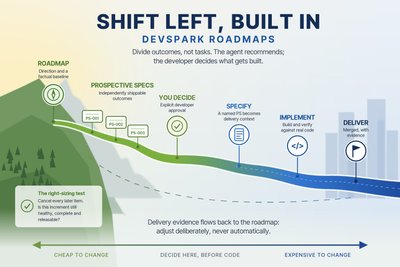
DevSpark already supports optional roadmaps, so I’m proposing to split them:
| Artifact | Purpose |
|---|---|
VISION.md | Purpose, users, capabilities, attributes, boundaries, and success criteria: the destination. |
ROADMAP.md | Current reality, vision delta, architectural strategy, experiments, delivery increments, and remaining work: the journey. |
No new commands or ceremonies. The existing implementation workflow handles the work in front of me, and what it produces becomes evidence for revising the roadmap.
Shift Left the Learning
Shifting left has usually meant moving testing and security earlier, because problems cost less when they’re found before much depends on them. AI lets me shift learning earlier too. Before I spend weeks debating a technical decision, I can sometimes build a working experiment in an afternoon.
That doesn’t mean every decision deserves five alternatives and a prototype. That would just rebuild the overhead I’ve been trying to eliminate. The goal is proportion: explore when the uncertainty is consequential, move fast when the path is obvious, and don’t mistake the amount of planning for the quality of the decision.
What I’m really after is lowering the cost of finding out I’m wrong. Finding out early is one of the best things that can happen to a software project.
Back to Dąbrowski
Mental models become comfortable, and comfortable models stop being questioned. Often it takes a failure to show their limits. Dąbrowski was writing about something far deeper than software, and refactoring an application is not psychological disintegration. But the parallel holds well enough to be useful: imagination, paired with cheap experiments, lets me break my own assumptions on purpose instead of waiting for a failure to do it for me.
I usually judge AI by its answers. Was it accurate? Did the code compile? This time the value was in the questions. I went looking for a name and came back asking what a roadmap is for. These DevSpark changes may or may not hold up; I’ll find out by using them. The change in perspective has already happened.
None of this replaces experience or judgment. When trying ideas gets cheap, the hard part becomes deciding which ones deserve my attention.
My daughter studied Dąbrowski in college. I ended up using him to rethink a roadmap. Not bad for a conversation that started with a name I couldn’t spell.
Explore More
- DevSpark Roadmaps: Planning Before the Agent Builds — Earlier context on DevSpark’s optional roadmaps and Prospective Specs.
- Ithaka Gave You the Journey: AI-Assisted Development — A related reflection on AI-assisted development as exploration and discovery.
- DevSpark: The Evolution of AI-Assisted Software Development — Earlier context for how DevSpark has changed over time.
- The Dependencies I Never Upgraded — A companion essay about how experience changes the way I evaluate software choices.
Related project evidence

DevSpark: Constitutional AI Governance Framework
DevSpark is a standalone AI-assisted development framework that extends Specification-Driven Development with constitution-based PR reviews, codebase-wide compliance auditing, adversarial risk analysis, brownfield constitution discovery, and adaptive lifecycle management. DevSpark makes project constitutions valuable throughout the entire development lifecycle — from greenfield planning through continuous constitutional governance.
Used across most of my active repositories, including this site

DocSpecSpark
Documentation-driven specification system for turning architectural intent into implementation context.
Working through something similar?
If this maps to something you're working on, I'm glad to compare notes. Start with the system and the constraint that matters most.