I'm Not a Game Developer. I Built a Game Anyway.
After one ad too many in a mobile puzzle game, I built my own in a week with Godot and DevSpark, despite never having written a game. The most useful moment was when the code passed every test and the puzzles still weren't fun. I'm asking readers to play it, read the code, and tell me whether shipping makes me a game developer.

DevSpark Series — 33 articles
- Taking DevSpark to the Next Level
- From Oracle CASE to Spec-Driven AI Development
- Fork Management: Automating Upstream Integration
- Why I Built DevSpark
- Getting Started with DevSpark: Requirements Quality Matters
- DevSpark: Constitution-Based Pull Request Reviews
- DevSpark: The Evolution of AI-Assisted Software Development
- DevSpark: Months Later, Lessons Learned
- DevSpark in Practice: A NuGet Package Case Study
- DevSpark: From Fork to Framework — What the Commits Reveal
- DevSpark v0.1.0: Agent-Agnostic, Multi-User, and Built for Teams
- DevSpark Monorepo Support: Governing Multiple Apps in One Repository
- Bring Your Own AI: DevSpark Unlocks Multi-Agent Collaboration
- Dogfooding DevSpark: Building the Plane While Flying It
- DevSpark: Constitution-Driven AI for Software Development
- The DevSpark Tiered Prompt Model: Resolving Context at Scale
- Workflows as First-Class Artifacts: Defining Operations for AI
- Closing the Loop: Automating Feedback with Suggest-Improvement
- Observability in AI Workflows: Exposing the Black Box
- Autonomy Guardrails: Bounding Agent Action Safely
- Designing the DevSpark CLI UX: Commands vs Prompts
- A Governed Contribution Model for DevSpark Prompts
- The Alias Layer: Masking Complexity in Agent Invocations
- Prompt Metadata: Enforcing the DevSpark Constitution
- DevSpark Blogging Workflow: How I Built Better Articles
- DevSpark and Agent Skills: Beyond Portable AI Capabilities
- The Methodology Tax: Why Grassroots Innovation Gets Rejected
- DevSpark's Next Evolution: Rethinking Where Knowledge Lives
- DevSpark v4: The Spec Was Never the Record
- DevSpark: Change Must Start With a Real Need
- I'm Not a Game Developer. I Built a Game Anyway.
- QA Was Always My Last Battle Front
- DevSpark Dogfooding: Escaping the Scope-Creep Spiral
Filed under Building software with AI
Topic cluster
DevSpark and Spec-Driven DeliverySpec-driven development, AI-assisted delivery workflows, governance, and the DevSpark toolkit.
Thirty Seconds of Fun
I like the arrow puzzle games on my phone. A screen full of tangled arrows, one of which has a clear path. You tap it, watch it slide away, and the knot slowly comes apart. It's a simple pleasure, right up until the game decides I've had thirty seconds of fun and now owe it an advertisement.
After one interruption too many, I had the thought that has gotten programmers into trouble for decades: how hard could it be to build this myself?
The honest answer was that I had no idea, because I'm not a game developer. I've spent thirty years designing and building software systems. I know architecture, requirements, testing, and the countless small decisions between an idea and working software. Godot, puzzle generation, game loops, and level design were all unfamiliar territory.
A week later I had ArrowSpark, an ad-free arrow puzzle game with no lives, no waiting, and no monetization machinery between you and the puzzle.
That leaves me with a question I still can't answer cleanly: does shipping a game make me a game developer?
Even Nothing Turned Out to Be Something
I wanted a tangled board of arrows and nothing else. That sounds like the easy part, and it wasn't.
An arrow in ArrowSpark isn't an icon pointing in one of four directions. It has a tail, and the tail can turn. Every segment has to connect cleanly to the next, without gaps or branches, and an arrow's own tail must never trap it. The moment arrows have bodies, the board stops being a grid of symbols and becomes a geometry problem.
Scoring followed, then multiple levels, hints, larger boards, zooming, and panning. Each one was a small feature on its own, and each one changed what the others needed to do.
Along the way the game picked up the design rule I'm proudest of: hard is fine, unsolvable is not.
The puzzles I enjoy make me stare at the screen until I spot the one arrow that frees the next, and the next, until the whole board comes apart. What I can't stand is a puzzle that looks hard only because the generator accidentally built something impossible. The first kind respects the player. The second is a bug wearing a difficulty setting.
Where the Process Came In
The other half of this story is how someone outside the domain got there at all. That's where DevSpark, my approach to spec-driven, AI-assisted development, did its work.
A prompt like "build me an arrow puzzle game" leaves every important question unanswered. What makes a puzzle valid? How do we measure difficulty? What does "done" mean? Those are software-development questions, and I know how to investigate software-development questions even when the stack is new to me.
So I treated ArrowSpark the way I'd treat any system. I broke each capability into a bounded spec, challenged the requirements, tested the implementation, reviewed the results, and recorded why each decision was made. The AI helped me find my way around Godot. I supplied the judgment about what we were building and why.
I suspect this is where a lot of the current conversation about AI and expertise goes wrong. It treats the tool as either a replacement for knowing things or a toy. In this project it was neither. It was closer to a very fast colleague who knew the engine better than I did and had no opinion about whether the game was any good.
The Test That Passed and Was Still Wrong
The most useful moment of the week came when the AI and I built something that worked and was still wrong.
We wrote a difficulty analyzer. It measured dependency chains between arrows, confirmed that every puzzle was solvable, and passed every test. By every measure I had written down, it was done.
Then I played the puzzles. They weren't much fun.
By my own rough rating they landed around two out of five on difficulty, regardless of what the analyzer reported. The code had faithfully implemented an incomplete understanding of the problem. Tests could tell me whether the system did what I specified. Only playing could tell me what the specification had missed.
I've seen this pattern in business software for years, usually with a dashboard that is technically correct and practically useless. I didn't expect to meet it again in a puzzle game, but the lesson transferred whole. A green test suite answers the question you asked. It stays silent about the question you should have asked. I wrote more about that gap in The AI Confidence Trap.
Evidence for Both Sides
That moment cuts both ways, and I'd rather lay out both readings than pick the flattering one.
A seasoned game designer might have recognized the problem earlier. They might never have trusted a dependency-chain metric to stand in for difficulty in the first place. That's evidence for "not a game developer."
But I caught it. I played the output, believed what I was seeing over what the analyzer reported, and revised the generation and validation approach instead of arguing with the results. That feels like evidence for the other side.
The specs, milestones, and account of that pivot are part of the project. The process left receipts, which means you don't have to take my word for any of this.
You Decide
ArrowSpark is young, and nearly all of its playtesting so far has been done by the person who designed it. That is a poor basis for any claim about whether a puzzle is good.
I need players who don't know what I intended. People who will tap the wrong arrow, find a level delightful or tedious, and discover that something I thought was obvious isn't. That's the one kind of feedback I can't generate myself.
You can weigh in from either side. Play the game, judge whether it holds up, and tell me through the survey. Or open the repository and judge the developer: the specs, the commits, the tests, the decisions, and the things that didn't work.
Does shipping this game make me a game developer? I have a working game and an incomplete answer, and I'd like your verdict.
Explore More
- Why I Built DevSpark — the spec-driven approach behind this project, and where it came from
- Getting Started with DevSpark — how the specify, plan, and implement flow works in practice
- The AI Confidence Trap — what happens when working code gets mistaken for correct code
- AI and Critical Thinking in Software Development — why judgment is still the human contribution
- Building ArtSpark: Where AI Meets Art History — another build that started outside my usual territory
Related project evidence
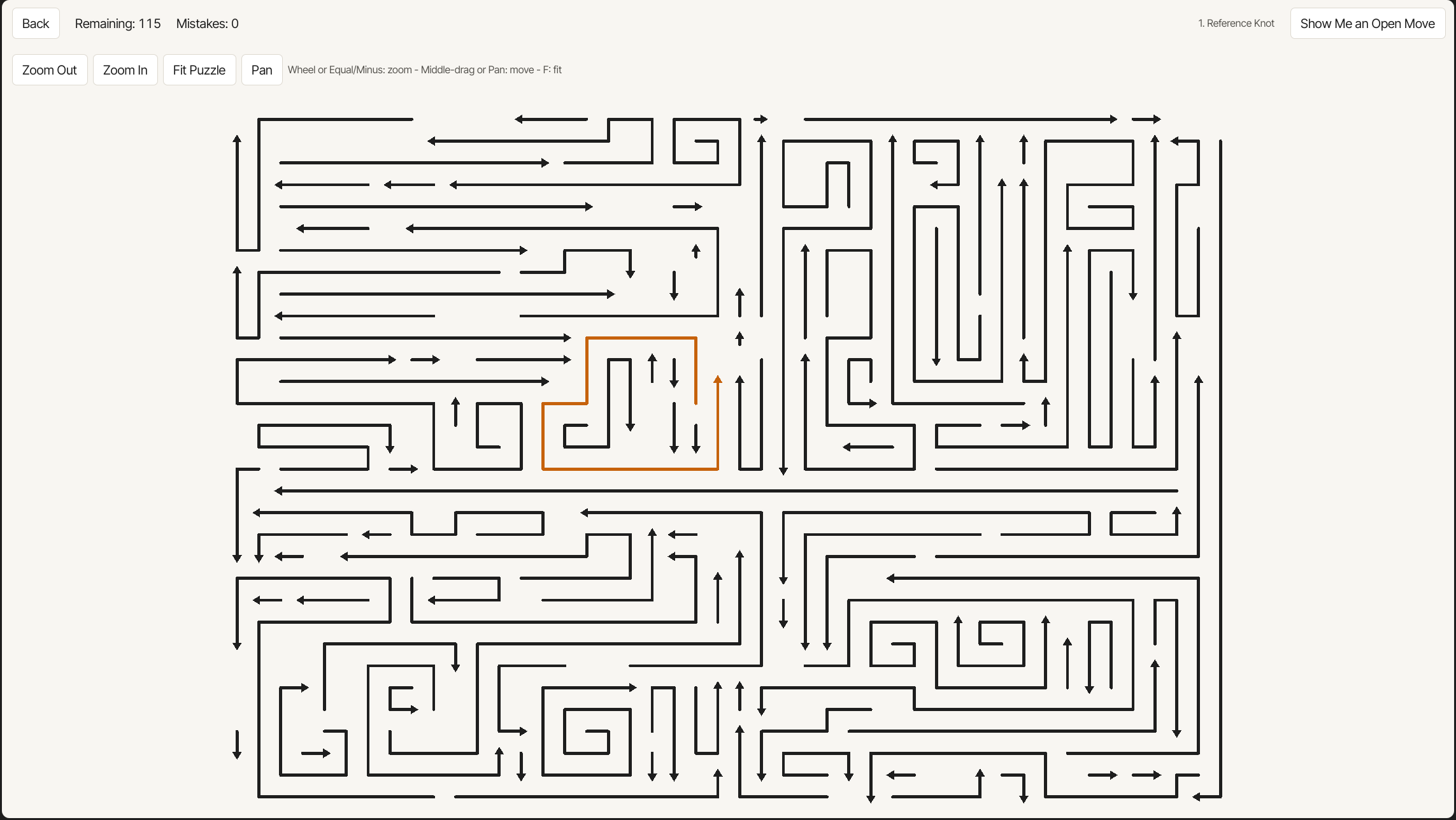
ArrowSpark
An ad-free arrow puzzle game with no lives and no waiting. Every puzzle is checked so it can be hard but never unsolvable.

DevSpark: Constitutional AI Governance Framework
DevSpark is a standalone AI-assisted development framework that extends Specification-Driven Development with constitution-based PR reviews, codebase-wide compliance auditing, adversarial risk analysis, brownfield constitution discovery, and adaptive lifecycle management. DevSpark makes project constitutions valuable throughout the entire development lifecycle — from greenfield planning through continuous constitutional governance.
Used across most of my active repositories, including this site
API Test Spark
A NuGet package that embeds an interactive API test harness into any .NET 10 Minimal API with one line of code. It reads the API's own OpenAPI contract, so there is nothing extra to keep in sync.
Thousands of NuGet downloads
Working through something similar?
If this maps to something you're working on, I'm glad to compare notes. Start with the system and the constraint that matters most.