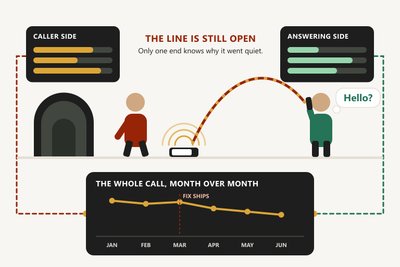
The Beaver Builds a Pond
DevSpark doesn't follow a fixed recipe, and neither does a beaver building a dam. Both read the specific conditions in front of them and build only what's needed — a look at why disciplined process and constant adaptation aren't opposites, and how good process gets maintained rather than rebuilt.
Leadership Philosophy Series — 13 articles
- The Power of Lifelong Learning
- AI and Critical Thinking in Software Development
- Sidetracked by Sizzle: Staying Focused on True Value
- The Managed Transition Model: Leadership Promotion as Power Exchange
- When the Pressure is On - Late Sprint Hotfix Governance
- Accountability and Authority: Walking the Tightrope
- Turtling: When a Team Stops Looking for the Door
- Every Arm Is Still Searching: The Octopus Model of Agency
- The Dependencies I Never Upgraded
- The Beaver Builds a Pond
- The Shark Stops Evolving When It's Done
- The Engineering Zoo: When the Dashboard Gets Better but the Zoo Does Not
- Tactical Excellence, Strategic Truth: Who Checks Whom
Filed under Leadership and systems thinking
Topic cluster
Project Leadership and DeliveryProject Mechanics, leadership judgment, delivery accountability, and team operating models.

People ask me how to use DevSpark like they're asking for a recipe.
What's the order of operations? Spec first, then plan? How long should each phase take?
I get it. A formula is comforting — the same steps produce the same result every time. But DevSpark doesn't work that way. Some projects I write the spec before the plan; others the plan comes first. Sometimes I skip straight to interrogating the repo before writing anything down. That variation isn't arbitrary — shuffling the steps every time isn't adaptability, it's inconsistency wearing a nicer name, and the two can look identical from the outside. The difference is whether the change follows from something I actually learned about the problem in front of me. I used to think I owed people a better explanation for why it kept changing. Then I thought about beavers.
A beaver doesn't build the same dam on every stream. It reads the water level, the width of the channel, what's already lying around — a fallen tree, a narrow point, a shelf of rock — and builds the dam that fits that stream. The pond is always the goal. The dam is never the same twice.
DevSpark is the dam. Excellent software is the pond.
Everyone thinks beavers build dams
They don't. They build ponds. The dam is how they get there.
A beaver doesn't wake up with an overwhelming desire to stack sticks across a stream. It wants something more practical: deep, still water around its lodge, a moat that keeps it out of reach of coyotes, bears, and everything else that can outrun a beaver on land but not outswim it in water.
The pond is the objective. The dam is the engineered response.
That distinction cuts both ways. Humans fall in love with implementations and forget what they were built for — the familiar failure. Less obvious: treating the dam as disposable because it's "just" the means. A good dam isn't trivial — it's accumulated knowledge, built deliberately, creating stable conditions other things depend on. The objective explains why the dam exists. It doesn't make the dam's quality optional.
A process is useful when it reliably moves a team toward the outcome it exists to produce. A meeting is useful when it resolves uncertainty. A dashboard is useful when it changes a decision. That's not a case against process — it's the test that keeps process honest.
Reading the water before you build
Here's something most people get backward about beavers: they don't build reflexively at the sound of running water. What triggers construction is water depth at the site — whether it's enough to keep an underwater entrance safe. Beavers assess, then decide whether and how to build, using what's already there and adapting technique to the hydrology in front of them.
This is the part people miss when they ask me for the DevSpark recipe. There isn't one, because there can't be one. The repo I'm working in, the team's experience level, the models available that week, the actual risk in the codebase — that's the hydrology. Plan-first-or-spec-first isn't a preference. It's a read of the site.
The methodology changes because the conditions change. The discipline is knowing why.
Adaptability isn't improvisation. It's attention.
Maintaining the dam
None of this means a dam gets rebuilt every time the water level moves an inch. A beaver doesn't tear down its work each season — it patches a leak, reinforces a weak section, extends the structure as the pond's needs grow. It earns trust over time precisely because it isn't reinvented on a whim.
Good process works the same way. Constantly overhauling how a team works is its own dysfunction — it burns the trust and muscle memory that made the process worth having. The better discipline: maintain what works, observe the environment, modify deliberately when evidence actually justifies it.
When the problem keeps coming back
Most of us solve recurring problems by expending recurring effort. The beaver solves recurring problems by changing the conditions that create them — investing real effort once so the river does useful work every day afterward. That's one way of thinking about agency, alongside a couple of others I've written about elsewhere.
Good leaders arrive at the same conclusion. If you're solving the same problem every week, you probably don't have a people problem — you have an environmental one. People don't repeatedly forget because they're lazy; the system makes forgetting easy. Teams don't wait for approvals because they're timid; the organization rewards waiting. New managers focus on people, experienced managers on teams; exceptional leaders eventually focus on systems, asking not how do I get people to behave differently but what environment produces the behavior I want.
That shift starts with noticing the same bottleneck on three unrelated projects, the same requirement misread by three different people — catching the pattern before anyone's named it, then asking whether the environment is producing the behavior, not the individual stuck inside it. You can fight those currents forever. Or you can change the river.
What beavers actually build
A single beaver dam can reshape a landscape. The pond becomes a wetland — one of the most productive ecosystems on Earth — filtering sediment, reducing downstream flooding, holding moisture in the ground during drought. Biologists call beavers a keystone species for exactly this reason: the benefits radiate far past the beaver that built it. The best engineering doesn't just solve the engineer's problem — it creates conditions other people can build a life around.
What's the pond
Before I commit to a next project, a next initiative, a next tool, the only question that matters is what's the pond.
If I can't clearly describe the environment I'm trying to create, I probably shouldn't be building a dam.
Because the dam was never the masterpiece.
The pond was.
Explore More
- Turtling: When a Team Stops Looking for the Door — another read on agency, where the turtle surrenders ownership instead of reading the environment
- Every Arm Is Still Searching: The Octopus Model of Agency — a look at agency through persistent, purposeful search
- Why I Built DevSpark — the origin story behind the methodology used as this piece's running example
- The Shark Stops When It's Done — the same discipline applied to a system instead of a stream: leave it alone once it's built only what it needs
- The Dependencies I Never Upgraded — another look at knowing when not to touch something that's already doing its job
Related project evidence

DocSpecSpark
Documentation-driven specification system for turning architectural intent into implementation context.

DevSpark: Constitutional AI Governance Framework
DevSpark is a standalone AI-assisted development framework that extends Specification-Driven Development with constitution-based PR reviews, codebase-wide compliance auditing, adversarial risk analysis, brownfield constitution discovery, and adaptive lifecycle management. DevSpark makes project constitutions valuable throughout the entire development lifecycle — from greenfield planning through continuous constitutional governance.
Used across most of my active repositories, including this site
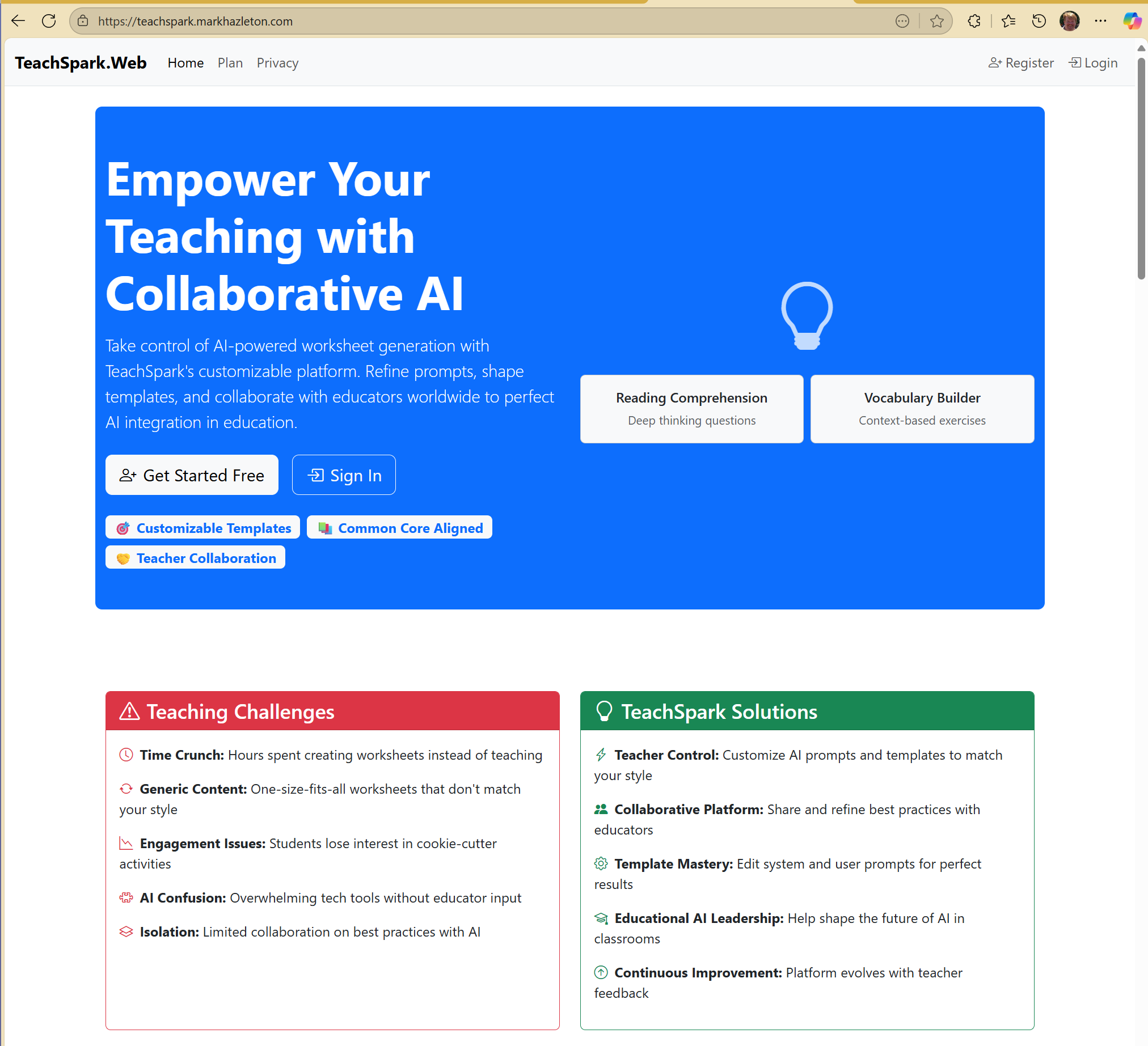
TeachSpark: AI-Driven Educational Platform
TeachSpark is an LLM-powered educational platform built with .NET 10 MVC and a Webpack 5 frontend build system. It provides adaptive learning with personalized content delivery, interactive curriculum with real-time feedback, progress analytics, and comprehensive code quality tooling (ESLint, Prettier, Husky).
Working through something similar?
If this maps to something you're working on, I'm glad to compare notes. Start with the system and the constraint that matters most.