Momentum Is Not Propulsion
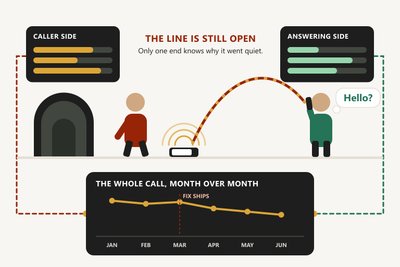
A business can keep moving long after its engine stops, the way a carrier coasts on its own mass. I look at Blockbuster's late fees, Stack Overflow's collapse in new questions, and the artisan who wins the quality argument but loses the economic one, and at what leaders owe the people who built the original engine.
Leadership Philosophy Series — 16 articles
- The Power of Lifelong Learning
- AI and Critical Thinking in Software Development
- Sidetracked by Sizzle: Staying Focused on True Value
- The Managed Transition Model: Leadership Promotion as Power Exchange
- When the Pressure is On - Late Sprint Hotfix Governance
- Accountability and Authority: Walking the Tightrope
- Turtling: When a Team Stops Looking for the Door
- Every Arm Is Still Searching: The Octopus Model of Agency
- The Dependencies I Never Upgraded
- The Beaver Builds a Pond
- The Shark Stops Evolving When It's Done
- The Engineering Zoo: When the Dashboard Gets Better but the Zoo Does Not
- Tactical Excellence, Strategic Truth: Who Checks Whom
- A Journeyman's Guide to Three-Week Sprints
- Momentum Is Not Propulsion
- The Last Generation of Masters?
Filed under Leadership and systems thinking
Topic cluster
Project Leadership and DeliveryProject Mechanics, leadership judgment, delivery accountability, and team operating models.
The Project Nobody Has Cancelled
A project can lose its business justification long before anyone cancels it. The sponsor who championed it moves on, the market it was meant to serve shifts, or a cheaper option appears somewhere else in the company. The team keeps delivering anyway. Stand-ups happen, the status report stays green, and the burndown chart slopes the way it should. By every measure the project tracks, it's healthy. The only thing missing is a reason for it to exist, and nobody has written that down yet.
I've seen enough of these to recognize the feeling, and lately I recognize it somewhere larger than a single project. AI is changing the economics of whole kinds of work, and the people doing that work are still busy. Customers still buy. Invoices still go out. Those are real facts, and they're the facts people point to when they say nothing important has changed. What they don't show is whether the reason customers paid in the first place is still there.
The Carrier With No Engines
The image I keep coming back to is an aircraft carrier at full speed when its engines stop. Something that heavy keeps moving for a long way, and the wake behind it looks exactly like the wake of a ship under power. Someone watching from the deck would see progress. They'd have to look in the engine room to know otherwise.
Businesses carry the same kind of mass. Contracts run for years. Customers renew because switching is a chore. A brand keeps drawing people who formed the habit a decade ago. Internal processes keep funding the things they've always funded. All of that produces revenue, and revenue looks like propulsion on a dashboard.
The leadership question is whether the revenue comes from an engine that's still running or from momentum that's slowly bleeding off. The two look identical for a while. That's what makes the question hard, and why it's so easy to put off.
What Late Fees Were Telling Blockbuster
Video rental is the example everyone reaches for, and it's worth looking at more carefully than the usual version, which casts Netflix as the visionary and Blockbuster as the fool.
Start with late fees. In 2000, Blockbuster collected nearly $800 million in late fees, about 16% of its revenue. Customers hated them. Anyone who rented movies in that era remembers racing a tape back before closing to beat the deadline, or paying a fee that cost more than the rental itself. On the income statement, late fees were a large, reliable revenue stream. In the customer's mind they were a penalty, and they would last only as long as customers had nowhere else to go.
The fee wasn't attached to anything customers valued. The movie was the product, and the fee was charged when people failed to bring it back on time. That made it vulnerable in a particular way: a competitor could remove it without removing anything customers wanted.
Netflix started by mailing DVDs, and its subscription model flipped the deal: keep a disc as long as you like, and when you send it back, the next one ships. No due dates, no late fees. Streaming, added in 2007, later removed the return altogether. Netflix kept the disc business running until it shipped its last envelopes in September 2023. Rather than abandon the old engine to build the new one, it let the DVD business keep paying the bills, and keep customers attached, while streaming grew into something that could carry the company on its own.
Blockbuster saw the threat. It launched its own DVD-by-mail service, and in January 2005 it dropped late fees, a move it expected to cost $250 million to $300 million in operating income that year. It ended up giving up around $400 million, and the company slid into losses. By then a competitor had built its business on not charging the fee Blockbuster had depended on for years. Add store leases, debt, and the economics of thousands of physical locations, and every transition was expensive. Blockbuster filed for bankruptcy in 2010.
Blockbuster was making money from a problem its competitor made disappear. Netflix never competed on a gentler late-fee policy; its subscription made the fee unnecessary. That's the clearest example I know of revenue that looks like propulsion and is really momentum. The income statement captured the money but not its growing fragility, and the same fee that produced the revenue was giving customers a reason to leave.
Redbox lost a different way. It optimized the physical model about as well as anyone could, with cheap rentals from a kiosk outside the grocery store, and it was excellent at what it did. The market for renting discs kept shrinking anyway, and in 2024 its parent company went through bankruptcy and the kiosks went dark. Being excellent at a model the market is leaving is a trap I'll come back to.
What separates these stories isn't intelligence. It's whether a company could build a replacement engine while the old one still provided enough momentum to pay for the work.
Creation Was Only Half the Product
Stack Overflow is the case I think about most, because I was part of its audience. For years, if I had a programming question, someone there had already answered it.
The model had two halves. Humans wrote answers for other humans to read, and the community ranked them. Votes, accepted answers, reputation points, and badges sorted the useful from the wrong, and the gamification gave people a reason to keep contributing. The evaluation was as much a part of the value as the content. An answer with three hundred upvotes and a green checkmark told me something a bare search result never could.
The creation half had peaked well before AI arrived. New questions topped out at around 207,000 in March 2014, and annual volume fell by about a fifth between 2016 and 2019. Part of that was success: once the archive had answered the common questions, a new developer's question was usually a duplicate, and a search found the answer without anyone posting. Part of it was culture. In a July 2019 post on the company blog, its director of public Q&A wrote that the problem was "on us," because of "how we designed the question asking and closing process." I was one of those newcomers: I posted a few times, didn't like how it went, and went back to reading.
Then generative AI made creating content fast and nearly free, and nobody had good techniques for evaluating it yet. In December 2022 Stack Overflow banned AI-generated answers outright. As an immediate decision, that was defensible. AI answers often contained convincing errors, automated evaluation was immature, reliable AI-assisted verification wasn't a solved problem, and the volunteer moderators had a legitimate concern about protecting quality. Where I'd fault the response is strategy, not the ban itself: it kept both halves of the model, creation and evaluation, reserved for humans, and treated a structural shift as a moderation problem.
The people defending that ban weren't wrong about quality. Early AI answers were often wrong in ways that sounded right. But I couldn't help thinking of carriage drivers pointing out, correctly, that the first automobiles broke down constantly. Being right about the flaws didn't change where the passengers were going.
There was another path, and it didn't require trusting the technology. Stack Overflow had spent years building systems for evaluating, ranking, and validating technical knowledge, which put it in an unusual position to experiment with AI as both a contributor and an evaluator. It could have kept unverified AI answers off the public site while trying AI-assisted moderation, automated checks on whether the code runs, answer validation, and new contribution models. Is this answer accurate? Does it answer the question that was asked? Does it add anything the existing answers don't? Those experiments might have failed, and in 2022 the technology may not have been ready. But running them would have taught the company how its users were about to change. You don't have to trust an emerging technology to recognize that you need to understand it.
Instead, to someone looking for answers, it looked like Stack Overflow was rejecting the content creator, the same reflex newcomers had been meeting for years, now applied at scale. The people with questions went where they got answers. Researchers estimated that posting activity fell by at least a quarter within six months of ChatGPT's release, and by mid-2026 the site was getting roughly 1,400 new questions a month, less than a single day's volume at its peak.
The tools kept closing the distance, too. Stack Overflow was always a place you went: leave the editor, search, read, come back, and adapt the answer to your own code. An assistant in the IDE answers where the work happens, with the context of the actual code, and an agent goes on to apply the fix. Even a perfect Stack Overflow, with AI evaluating every answer, would still be a tab to switch to, and that trip gets harder to justify every time the tools improve. AI as evaluator probably wouldn't have saved it as a destination. It might have made it the trusted source the tools draw on.
Put together, Stack Overflow faces three problems that feed each other. The community that created, evaluated, and maintained the knowledge is disappearing. Without that community, the archive is at growing risk of going stale, because frameworks and APIs keep changing while the answers about them stop being revisited. And the reason to visit at all is disappearing, as the tools answer, apply, and check fixes without the developer leaving the editor. Even a perfectly maintained archive would face falling demand as a destination.
The archive still has real value, especially to AI providers, which is what the licensing deals are about. But accumulated knowledge isn't a perpetual-motion machine, and the engine that replenished it is running nowhere near its old rate. There's an irony in that. Stack Overflow helped build the body of technical knowledge that made AI coding assistants useful, and those assistants are now removing the incentive to replenish it.
This is where the carrier comes back. The company is still moving. Its owner, Prosus, reports Stack Overflow revenue of $129 million for the year to March 2026, up 12%, in a stretch when new questions on the public site fell by nearly three quarters in a single year. Prosus has also written off about 87% of what it paid for the business. Readership hasn't vanished and the business isn't failing, but growing revenue on top of a community engine that has nearly stopped is about as clear a picture of momentum as I know.
In June 2026 the company launched Stack Overflow for Agents, an API-first platform where AI agents contribute knowledge that humans review and own, with trust and verification built into the design. That's close to the path I'm describing, and I hope it works. It arrived after most of the community that would have evaluated that content had moved on, and the archive paying the bills gets older every month. Whether the company survives and whether its original knowledge engine survives are separate questions.
The collapse has a second cost that never shows up in Prosus's results. For a generation of developers, Stack Overflow was a public place to learn from each other's answers, corrections, and arguments. I look at what losing it means for how developers build judgment in The Last Generation of Masters?
The Artisan's Trap
Redbox showed that trap at the scale of a company. It's harder to watch in a person, and that's the part I find most uncomfortable.
Picture a graphic designer with thirty years in the field. Over those years they've learned to interview a client, understand how the business makes money, and build a visual identity that tells a coherent story. Show them an AI-generated logo and they'll spot the problems in seconds: derivative shapes, careless typography, no strategic thinking behind any of it. They're right.
But the designer is asking whether AI can do the work as well as they can. The owner of a three-person landscaping company is asking something else: is this good enough for my truck and my website, at a price I can pay today? For a lot of buyers, the answer is yes. The designer can win the argument about quality and still lose the argument about economics.
That's the trap. Years of experience make every flaw obvious, and they make it natural to judge a new tool against the best professional standard instead of against what the buyer will accept. The expertise is real. What has changed is how much of it the market will pay for, and for which jobs.
The same split runs through software. Drawing a logo is a different skill from understanding a brand, and writing code is a different skill from understanding a system. AI is commoditizing much of the production while making experienced judgment more valuable for the people who have it. Both are true, and the second doesn't guarantee that the same number of people get paid to do the same work.
Most of the reassurance I hear rests on what AI can't do well today. Those limits are real, and some of them, around trust, liability, regulation, and the relationships that keep clients coming back, may hold for a long time. But today's output quality is a snapshot, not a ceiling, and a profession's economics can change long before it's replaced perfectly. Being replaced well enough, for enough of its customers, is all it takes to shrink the market that's left.
What Leaders Owe Their People
A declining business model doesn't demand an immediate shutdown. Leaders have honest choices: harvest the remaining value deliberately, reinvent the offering, or plan an orderly exit. Each of those can be the right call when the economics, timing, and risks are on the table. Continuing an old business is a legitimate decision. Continuing it without admitting that its underlying assumptions have changed is where the damage happens.
The most dangerous practices in a business are often the ones still working financially while the reasons for their success disappear. The leadership challenge is telling current performance apart from future viability, and that takes better questions than revenue, utilization, retention, and delivery metrics, which are lagging indicators of relevance. Are new customers arriving for the same reasons they used to? How much of today's demand comes from people who still need the product, and how much from people who just haven't changed their habits yet? Is any of the revenue coming from customer frustration rather than customer value? Is this year's investment building future value, or protecting the appearance of past success?
Run those questions against Blockbuster and Stack Overflow, and the answers were visible years early. Blockbuster's late fees were revenue generated by dissatisfaction, collected from people who resented paying them and sustained partly because they had few alternatives. The financial statements showed the money. Only an honest look at how customers felt about paying it would have shown how fast it would turn once an alternative showed up.
Stack Overflow around 2016 would have passed almost any traditional review. Traffic was enormous, the archive was the first search result for nearly any programming error, and the brand was everywhere. But the number that measured the engine, new questions from new contributors, had already turned down, and the company's own blog would soon admit that the way it closed questions was part of the reason. Revenue and page views described the wake; question volume described the engine.
None of this is a celebration of displacement. It's genuinely sad to watch someone who devoted a career to excellence discover that the market won't reward it the way it used to. Some will reinvent their work. Some will serve a premium niche where the difference still matters to buyers. Others will face a hard transition. They deserve honesty about the economics and a real chance to adapt, rather than reassurance that the old model will last forever because it has lasted this long.
Loyalty to the people who built the original engine doesn't require loyalty to the engine itself. Preserving the old model is rarely the best way to protect the people who built it. Telling them the truth early, while there's still momentum to pay for a transition, usually is.
The Mission Was Never the Engine
I've spent my career building software, and the languages, platforms, and delivery methods have changed under me more times than I can count. Through all of it, my job was to solve problems for people who needed them solved. Typing code was how I did that for a long time. It was never the point, and that's what makes this shift something I can work with instead of something I have to defend against.
An organization can optimize the wrong business model as surely as a developer can optimize the wrong solution, and both happen when attention to how outpaces understanding of why. That's the distinction I'd want any team to make before the momentum runs out. The crew can keep the brass polished and the decks clean, and the ship will keep moving for a while. Somebody still has to go below and check whether the engines are running, and if they aren't, start building the next one while there's still enough headway to do it.
Explore More
- The Last Generation of Masters? — the companion piece: what happens to apprenticeship when AI makes the master faster alone
- AI and Critical Thinking in Software Development — how AI makes it easier to produce good work and easier to stop doing the thinking behind it
- The Shark Stops When It's Done — telling activity apart from attention, and knowing when to stop
- From Features to Outcomes: Keeping Your Eye on the Prize — why business value is what gets delivered, and the feature list is only the vehicle
Related project evidence
API Test Spark
A NuGet package that embeds an interactive API test harness into any .NET 10 Minimal API with one line of code. It reads the API's own OpenAPI contract, so there is nothing extra to keep in sync.
Thousands of NuGet downloads
ArrowSpark
An ad-free arrow puzzle game with no lives and no waiting. Every puzzle is checked so it can be hard but never unsolvable.

WichitaSewer.com
The website for Wichita Sewer and Drain Service, a new local business, built so customers could find it and call from day one.
Live since 2024 and still maintained
Working through something similar?
If this maps to something you're working on, I'm glad to compare notes. Start with the system and the constraint that matters most.