Grace Hopper: The Admiral Who Taught Computers Our Language
A clip of Grace Hopper on David Letterman, holding a piece of wire that made a nanosecond something you could hold, took me back to the 1980s. This tribute follows her from Vassar to the Harvard Mark I, the first compiler, COBOL and the Navy, and asks what her career says about AI-assisted development today.

Technology Series — 3 articles
- ReactSpark: A Comprehensive Portfolio Showcase
- Python, Spam, and the Holy Grail: A Language History
- Grace Hopper: The Admiral Who Taught Computers Our Language
Filed under Pragmatic architecture and modernization
Topic cluster
Software Development Patterns.NET development, API integration, implementation patterns, and the trade-offs that show up in working code.
An Unexpected Guest on David Letterman
I loved watching David Letterman, and I watched a lot of him in the 1980s. That was also when my interest in software development started. His show was irreverent, unpredictable, and frequently featured guests who seemed completely out of place on late-night television. That was part of the fun. You never quite knew what you were going to get.
In 1986, one of those guests was Rear Admiral Grace Hopper. She was 79 years old, recently retired from the United States Navy, and had spent much of her professional life doing things that most people didn't even know were possible.
One of Hopper's most memorable teaching techniques was demonstrating the length of a nanosecond. A nanosecond is one billionth of a second. That's a number we can write down, but it's almost impossible to visualize. Hopper made it tangible. She would hold up a piece of wire approximately 11.8 inches long and explain that it represented the distance light could travel in a nanosecond.
She took an almost incomprehensibly small unit of time and turned it into something you could hold in your hand. She wasn't dumbing down the science. She was making it accessible. She understood that explaining something complicated isn't necessarily about using simpler words. Sometimes it's about finding a completely different way to help someone understand.
Here was this tiny, sharp-witted Navy admiral talking about computers with David Letterman. She was funny, confident, and completely comfortable explaining complicated technical concepts to an audience that probably hadn't given much thought to how computers actually worked. My memory of that night is hazy, and I can't say for certain that I saw it live. But when I came across the clip again, it took me straight back to that time in my life, when I was first getting curious about how software worked.

Commodore Grace M. Hopper, official U.S. Navy portrait by James S. Davis. Public domain, via Wikimedia Commons.
Looking back, I think that was one of the things that made Grace Hopper so extraordinary. She wasn't just helping computers understand people. She was helping people understand computers, and she had been doing both for decades.
A Curious Girl Who Took Apart Clocks
Grace Brewster Murray was born on December 9, 1906, in New York City. She grew up in a family that valued education and encouraged curiosity.
One of the best-known stories about Hopper's childhood involves alarm clocks. As a young girl, she wanted to understand how an alarm clock worked, so she took one apart. Then another. Eventually, according to the story, she had dismantled several clocks before her mother intervened. It's a wonderful illustration of the curiosity that would characterize her entire life. She wasn't satisfied knowing that something worked. She wanted to know how it worked.
Hopper attended Vassar College, graduating Phi Beta Kappa in 1928 with degrees in mathematics and physics. She continued her education at Yale University, earning a master's degree in mathematics in 1930 and a PhD in 1934. That alone was a remarkable accomplishment for a woman in the 1930s.
She began teaching mathematics at Vassar in 1931 and appeared to be following a successful academic career.
Then World War II changed everything.
A Mathematician Goes to War
After the attack on Pearl Harbor, Hopper wanted to contribute to the war effort, and the Navy initially rejected her. She was considered too old for the normal enlistment requirements, and her small stature presented another obstacle.
Hopper persisted.
In 1943, she received permission to join the U.S. Naval Reserve and attended the Navy's women's midshipman training school at Smith College. She graduated in 1944 and was commissioned as a lieutenant junior grade. Her assignment would change the course of her life and contribute to changing the history of computing. She was sent to Harvard University to work on the IBM Automatic Sequence Controlled Calculator, better known as the Harvard Mark I.
The Mark I was an enormous electromechanical computer, approximately 51 feet long and weighing several tons. It wasn't a computer in the modern sense. There was no graphical interface, no operating system as we understand it, and certainly no convenient programming language. Programming required an intimate understanding of the machine itself.
Hopper became one of its first programmers, working under Howard Aiken. The team performed calculations essential to the war effort, including ballistic trajectories, anti-aircraft firing tables, and minesweeping operations.
She also wrote the Mark I's operating manual, a document of more than 500 pages. That may not sound glamorous, but anyone who has worked in software development understands how important good documentation can be. Hopper was helping establish not only how computers operated, but how people could systematically work with them. She had discovered the field that would occupy the rest of her life.
The Woman Who Wanted Computers to Understand English
After the war, Hopper faced a decision. She could return to Vassar and pursue a traditional academic career, or she could continue working with computers. She chose computers.
In 1949, she joined the Eckert-Mauchly Computer Corporation, which was developing UNIVAC, one of the earliest commercial electronic computers. At the time, programming was extraordinarily difficult. Computers operated using machine instructions. Programmers needed detailed knowledge of the underlying hardware, and software was closely tied to the specific machine on which it ran.
Hopper believed there had to be a better way. Why should people have to learn the computer's language? Why couldn't the computer learn to work with ours? That question helped change software development.
The Birth of the Compiler
In 1952, Hopper developed the A-0 system, widely recognized as one of the earliest compiler systems. A-0 wasn't a modern compiler in the sense that we use the term today. It automated the selection and linking of previously written routines, reducing the amount of low-level programming required.
But the underlying idea was revolutionary. A programmer shouldn't have to describe every individual operation the computer needed to perform. The computer should be able to translate a higher-level description into the instructions necessary to accomplish the task.
Today, we take that idea for granted. We write C#, Python, JavaScript, or any number of other programming languages without manually translating every operation into machine instructions. Hopper helped establish the foundation for that approach.
I should be honest about my own relationship to that idea. The compiler is a tool, and it was never what drew me into software development, or more accurately, application development. Finding a business problem and solving it with software was much more interesting to me. My first job, in high school, was with a small research firm where economists and sociologists were collecting data, and the first problem they challenged me with was how to print a bar chart driven by that data. It sounds trivial today, but it was the first thing I worked on, and I wanted to figure it out. Later, in a college work program, I led a retail store whose system placed orders based on sales alone. It didn't account for breakage, theft, or variations of the same item. Those were business problems I wanted to solve, not an engineering need to understand a compiler.
Hopper's compiler matters to me for that reason: it moved more of the work toward the problem and away from the machine. And she wasn't finished.
FLOW-MATIC and the Road to COBOL
Hopper believed computers needed programming languages that ordinary business professionals could understand. In the 1950s, she and her team developed FLOW-MATIC, a programming language designed for business data processing that used English-like commands. This was a significant departure from the mathematical and machine-oriented programming systems that dominated early computing.
Hopper's work helped influence the development of COBOL (Common Business-Oriented Language), which emerged in 1959 through a collaborative effort involving government, industry, and computer manufacturers. It's important to give credit accurately. Hopper did not single-handedly invent COBOL. Many talented people contributed to its development, including Jean Sammet and other members of the CODASYL committees.
But Hopper's pioneering work on FLOW-MATIC, her advocacy for machine-independent programming languages, and her efforts to promote standardization were foundational to COBOL's success. COBOL made it possible for organizations to build business applications using a relatively standardized language rather than developing entirely machine-specific software. Payroll systems, banking applications, insurance processing, and government systems could be implemented using a common approach.
Some of those systems, or their descendants, remain in service today. Hopper helped establish ideas in the 1950s that continued influencing enterprise software development more than seventy years later.
The Most Famous Computer Bug
No discussion of Grace Hopper would be complete without mentioning the moth. In September 1947, engineers working on the Harvard Mark II discovered that a moth had become trapped in one of the machine's electromechanical relays. They removed the moth and taped it into the computer's logbook, describing it as an actual case of a bug being found. The story became legendary.

The logbook page with the moth, September 1947. U.S. Naval Historical Center photograph NH 96566-KN, public domain, via Wikimedia Commons. The original is preserved by the Smithsonian.
Hopper is frequently credited with inventing the terms computer bug and debugging, but that's not historically accurate. Engineers had been using the term bug to describe mechanical and electrical problems long before electronic computers existed. What Hopper and her colleagues contributed was a particularly memorable example of the expression.
The story survived because it was funny, relatable, and wonderfully literal. It also reflected Hopper's personality. She understood the value of humor in explaining technology.
Amazing Grace: A Navy Career That Wouldn't End
Hopper's civilian computing career was extraordinary, but her military career was equally remarkable. She remained affiliated with the Naval Reserve throughout much of her work in commercial computing. In 1966, Navy regulations forced her to retire at age 60. She wasn't happy about it, but the Navy soon discovered that it still needed her expertise.
In 1967, she was recalled to active duty to help standardize the Navy's increasingly complicated collection of programming languages and computer systems. This was not a minor assignment. As computers became more common throughout the military, incompatible systems and inconsistent programming practices created enormous operational challenges. Hopper understood that standardization was what let large organizations function effectively.
She continued serving, and kept serving. In 1983, she was promoted to commodore. In 1985, following a change in the Navy's rank structure, she became a rear admiral. When she finally retired in August 1986, she was 79 years old and the oldest active-duty commissioned officer in the United States armed forces.
Her retirement ceremony took place aboard the USS Constitution, the Navy's oldest commissioned warship. There is something wonderfully appropriate about that setting: one of America's oldest naval vessels hosted the retirement of a woman who had spent her career helping build the future. Her colleagues affectionately called her Amazing Grace, and it was a well-earned nickname.
A Teacher Who Could Make a Nanosecond Visible
Despite her accomplishments in mathematics, programming languages, and military leadership, Hopper was also an extraordinary educator. She traveled extensively, delivering lectures to students, engineers, military personnel, business leaders, and anyone else willing to listen. She had little patience for unnecessary complexity or the argument that something couldn't be done simply because nobody had done it before.
Her demonstrations became legendary. Beyond the nanosecond wire, she used a much longer length of wire, approximately 984 feet, to represent the distance light travels in a microsecond. These weren't merely amusing props. They helped people understand the physical limitations of computing. Electrical signals take time to travel. Distance matters. Hardware architecture matters. An audience could understand those concepts without first studying electrical engineering.
That's what impresses me when I watch her appearance on David Letterman. She wasn't showing off how much she knew. She was sharing what she knew in a way that made other people want to understand it. There is a tremendous difference.
Throughout my career, I've found that one of the most valuable skills in technology is the ability to translate complex technical concepts into something meaningful for people who don't live and breathe technology every day. Business leaders don't necessarily need to understand every detail of an application architecture. They need to understand what it enables, what constraints exist, what decisions matter, and what risks they're accepting. Hopper demonstrated that kind of communication long before anyone was talking about solution architecture as a profession.
She Never Really Retired
After retiring from the Navy in 1986, Hopper joined Digital Equipment Corporation as a senior consultant. She continued speaking, teaching, and promoting computer literacy well into her eighties.
Her accomplishments received extraordinary recognition. In 1973, she became the first woman and first American named a Distinguished Fellow of the British Computer Society. She received more than forty honorary degrees. In 1991, President George H. W. Bush awarded her the National Medal of Technology.
Grace Hopper died on January 1, 1992, at age 85. She was buried with full military honors at Arlington National Cemetery. But the recognition didn't stop. In 1997, the United States Navy commissioned the USS Hopper (DDG-70), a guided-missile destroyer named in her honor. In 2016, President Barack Obama posthumously awarded her the Presidential Medal of Freedom. The Grace Hopper Celebration of Women in Computing, established in 1994, became a major international gathering dedicated to recognizing and advancing women in technology.
Her name remains associated with innovation, education, and the belief that computing should be accessible to more people. That's quite a legacy for a curious little girl who wanted to know how alarm clocks worked.
Grace Hopper and the Next Generation of Software Development
When I think about Hopper's career, I see an interesting parallel with the changes we're experiencing in software development today. In the 1950s, many programmers believed that writing machine-level instructions was fundamental to their profession. Hopper challenged that assumption. She believed computers should do more of the mechanical work so people could concentrate on solving problems.
Today, artificial intelligence is challenging another set of assumptions about how software should be developed. AI-assisted development is making it possible to produce code, tests, documentation, and even substantial application components with far less manual effort than before. Some people see that as a threat to software development. Others see it as an opportunity. Hopper's career suggests that this tension is nothing new.
There is an important distinction, though. Traditional compilers translate programs according to deterministic rules. Generative AI produces outputs probabilistically, which introduces new challenges around reliability, validation, and accountability. The tools are different, but the broader question remains familiar: what work should we ask computers to do, and where should people concentrate their attention?
For Hopper, the answer was never simply to make programmers faster. It was to make computing more useful and accessible. That's a philosophy I've come to appreciate throughout my own career. I've worked with enough programming languages, frameworks, development methodologies, and architectural approaches to recognize that the tools will keep changing. The challenge is not to become so attached to a particular tool that we forget what we're trying to accomplish. The goal is to solve the problem, and when we've solved it, get out of the way.
Celebrating a Remarkable Life
Grace Hopper deserves to be remembered for much more than COBOL, the first compiler, or a moth in a computer. She was a mathematician who earned a doctorate when relatively few women had the opportunity. She was a Navy officer who persisted when the military initially rejected her. She was a pioneering programmer who helped establish an entirely new profession, an innovator who challenged conventional thinking about how humans should interact with computers, and a teacher who could make a billionth of a second understandable with a piece of wire.
She was also a 79-year-old rear admiral who could sit across from David Letterman and make computer science entertaining. That last accomplishment might seem minor compared with everything else, but it mattered to me. I watched Letterman in those years because I enjoyed the show, not because I was looking for a lesson in the history or future of software development. I can't say whether Hopper's visit was part of what sparked my interest, but seeing the clip again reminded me of that time, and it made me want to look deeper at who she was.
Forty years later, after a career spent building software, solving business problems, and trying to make complicated systems understandable, I still appreciate what she demonstrated in that clip. Technology advances when people challenge the limits of what's possible. But it becomes truly valuable when someone can make those advances understandable and useful to others. Grace Hopper spent her life doing both, and that's a life worth celebrating.
Explore More
- English Is the New Programming Language of Choice — Hopper's question about computers learning our language, asked again with large language models
- AI and Critical Thinking in Software Development — where people should concentrate their attention when the machine does more of the work
- Python, Spam and the Holy Grail — another piece of computing history told through its people
- Adapting with Purpose: Lifelong Learning in the AI Age — staying curious while the tools keep changing
References and Further Reading
- Yale University: Biography of Grace Murray Hopper
- Smithsonian Institution: Grace Hopper, The Navy and Computers
- Naval History and Heritage Command: Rear Admiral Grace Hopper
- National Women's History Museum: Grace Hopper
- David Letterman: Grace Hopper Is the Computer Queen (1986)
- Smithsonian Magazine: Grace Under Pressure
Related project evidence
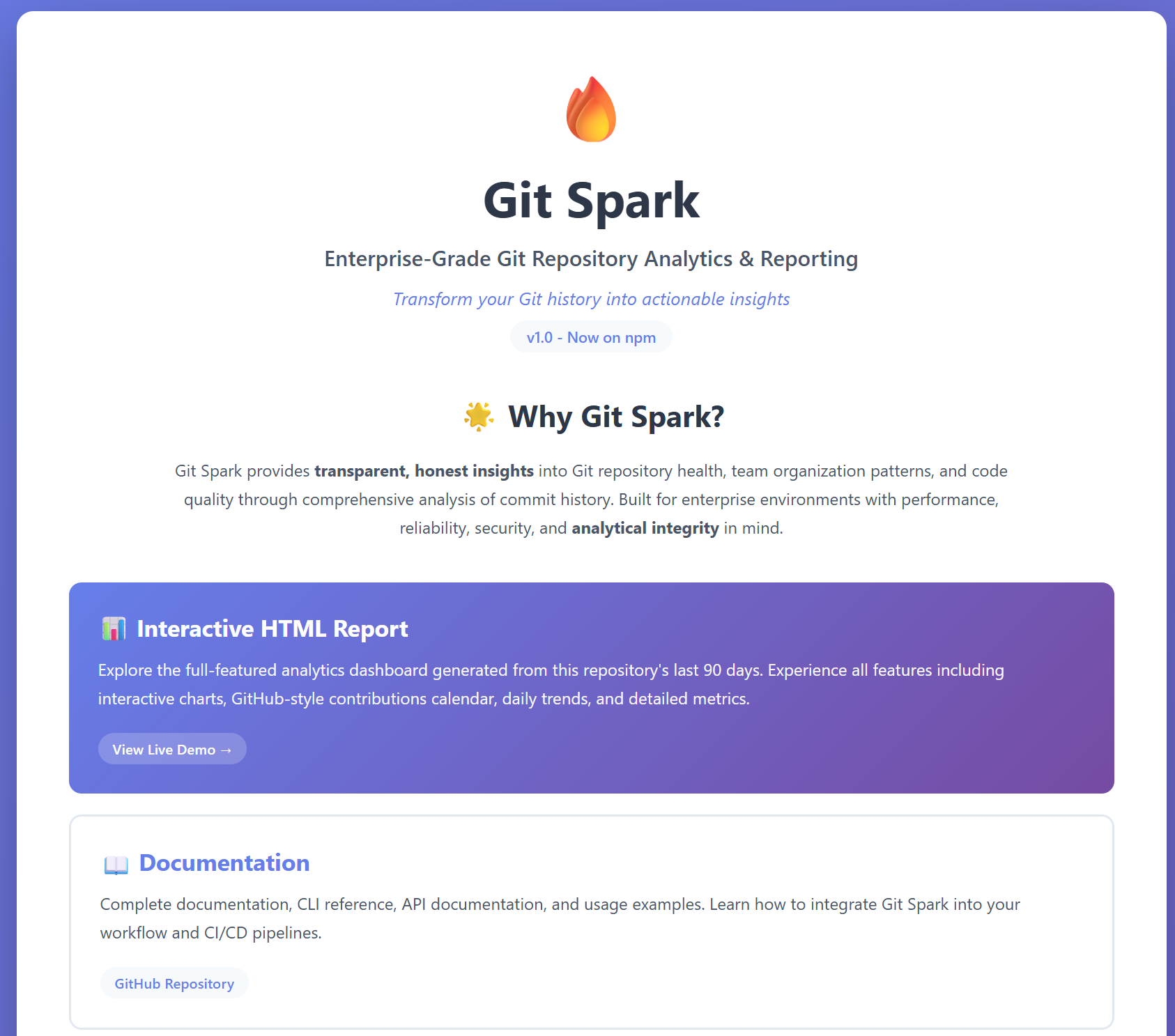
Git Spark: Advanced Git Repository Analytics Tool
Git Spark is an npm CLI tool and Node.js library that analyzes Git repository commit history to provide insights into contributor activity, code changes, and development patterns. Generates interactive HTML reports with charts, plus JSON, CSV, and Markdown exports.
Thousands of npm downloads
DevSpark: Constitutional AI Governance Framework
DevSpark is a standalone AI-assisted development framework that extends Specification-Driven Development with constitution-based PR reviews, codebase-wide compliance auditing, adversarial risk analysis, brownfield constitution discovery, and adaptive lifecycle management. DevSpark makes project constitutions valuable throughout the entire development lifecycle — from greenfield planning through continuous constitutional governance.
Used across most of my active repositories, including this site

KeyPressCounter
Lightweight Windows system tray utility monitoring keyboard and mouse input activity alongside real-time system performance metrics and usage statistics.
Working through something similar?
If this maps to something you're working on, I'm glad to compare notes. Start with the system and the constraint that matters most.