The Managed Transition Model: Leadership Promotion as Power Exchange
Leadership promotions are often celebrated as milestones, but the real work begins in the transition of authority, identity, and responsibility. The Managed Transition Model, grounded in MEMC's Model-Netics, reframes promotion as a coordinated exchange of power between outgoing and incoming roles.
Leadership Philosophy Series — 6 articles
- The Power of Lifelong Learning
- AI and Critical Thinking in Software Development
- Sidetracked by Sizzle: Staying Focused on True Value
- The Managed Transition Model: Leadership Promotion as Power Exchange
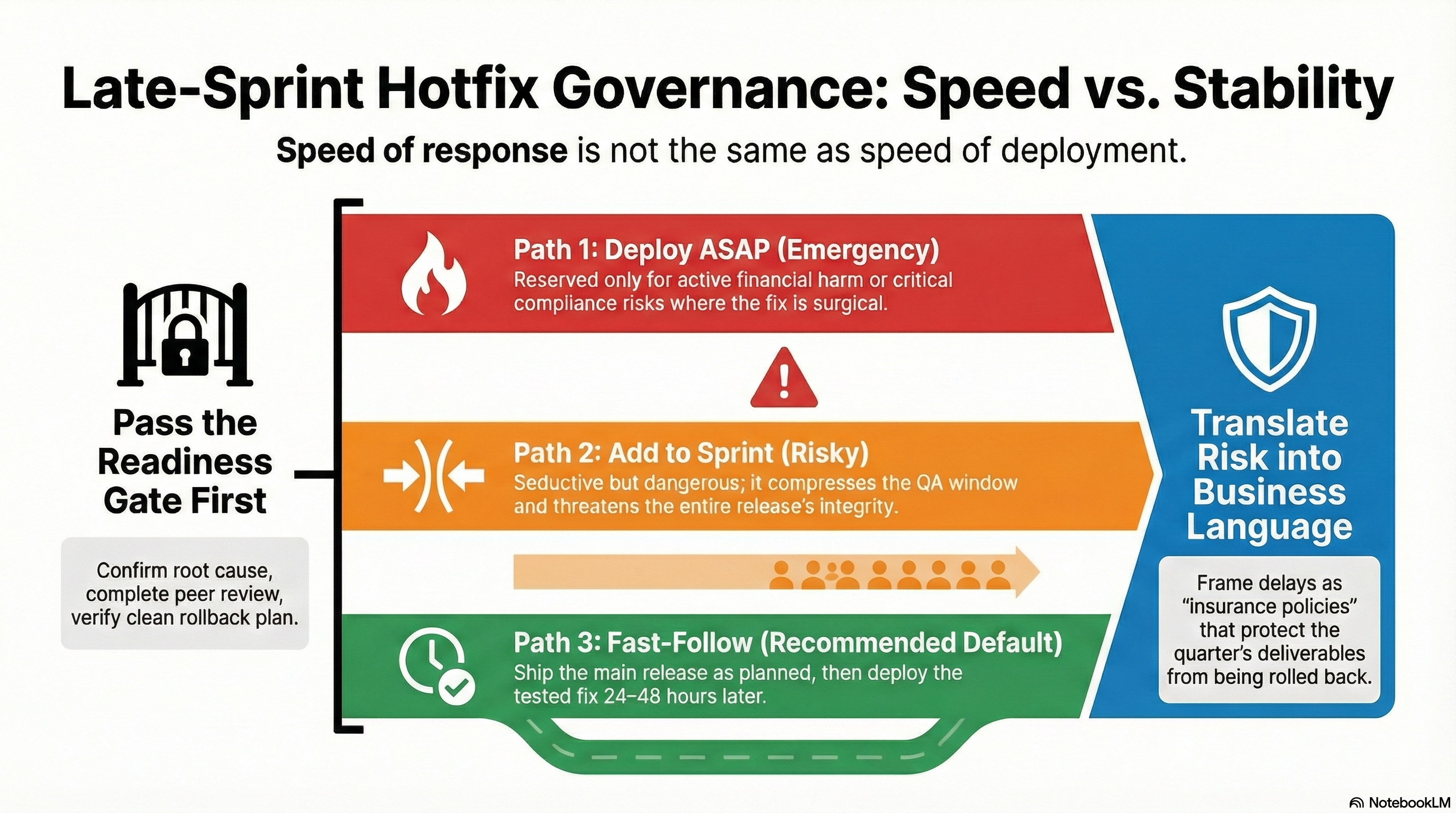
- When the Pressure is On - Late Sprint Hotfix Governance
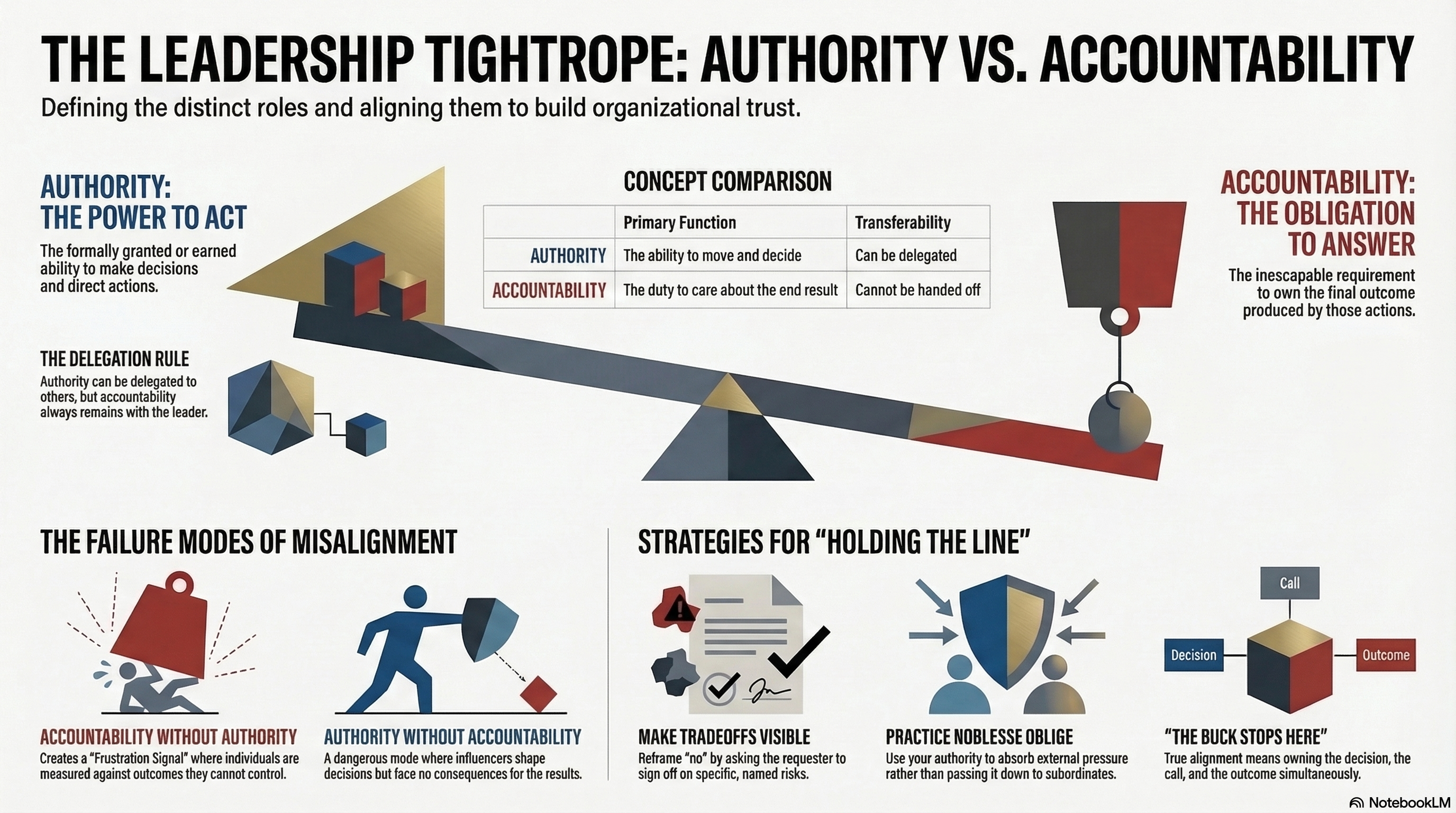
- Accountability and Authority: Walking the Tightrope
Deep Dive: The Managed Transition Model
The Managed Transition Model
A Unified Theory of Leadership Promotion and Power Exchange
Leadership promotions are often treated as celebratory milestones—an announcement, a title change, a new office. In reality, the most consequential aspect of promotion is not the event, but the transition of authority, identity, and responsibility that follows. I've watched enough promotions play out over the years to know that the celebration fades quickly, and what remains is the hard, often invisible work of actually becoming the leader the role demands.
The Managed Transition Model offers a unified framework for navigating this moment successfully. Rather than viewing promotion as a singular step upward, the model reframes it as a coordinated exchange of power between the outgoing role and the incoming one.
This perspective is grounded in the principles of Model-Netics, the comprehensive management development system created by the Main Event Management Corporation (MEMC) under the leadership of Harold S. Hook. Model-Netics' 151 management models function as practical guides to thought and action—turning abstract leadership theory into operational behavior. What makes these models enduring is their simplicity: they give leaders a shared vocabulary for situations that are otherwise difficult to discuss.
To visualize the transition, the model draws on a memorable metaphor: Doctor Dolittle's Pushmi-Pullyu, a two-headed creature that must coordinate opposing forces to move forward.
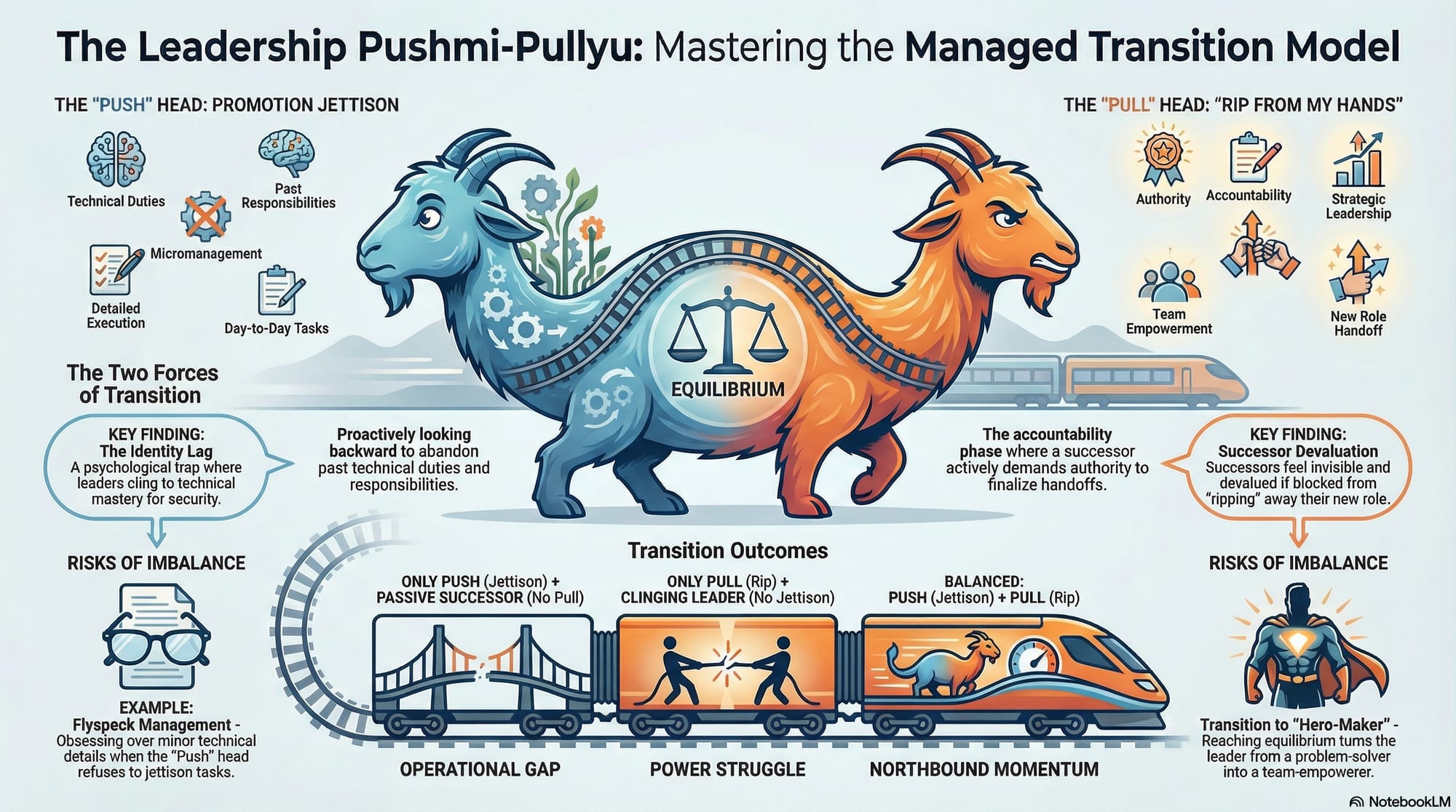
A successful promotion requires the same dual motion:
- An internal push away from the past
- An external pull toward new authority
- A shared destination that aligns both forces
When these elements synchronize, leadership transitions become smooth accelerators of organizational momentum. When they do not, friction, confusion, and stagnation follow.
The Internal Push: Promotion Jettison (Model #114)
The first "head" of the Pushmi-Pullyu represents Promotion Jettison—the disciplined act of releasing former duties to fully inhabit a new role.
This is where most promotions quietly fail.
Identity Lag
Leaders promoted for execution excellence often retain the self-image of a trusted doer rather than adopting the mindset of a strategic decision-maker. I've experienced this myself. There's a comfort in the work you know, and a vulnerability in the work you're still learning. The result is an identity lag:
- The title changes
- Expectations change
- Behavior does not
Without intentional jettisoning, the leader remains psychologically anchored to yesterday's job. They keep attending meetings they no longer need, reviewing work they should be delegating, and solving problems that belong to someone else now. It feels productive, but it's actually a form of avoidance.
The Competence Trap
High performers frequently define their value through technical mastery. Letting go of hands-on work can feel like surrendering the very capability that earned the promotion.
This creates what I think of as the Competence Trap: clinging to old strengths prevents development of new ones. Instead of scaling impact through leadership, the promoted individual becomes a bottleneck disguised as a hero. The team learns to route everything through the new leader—not because it's efficient, but because the leader hasn't created space for others to own outcomes.
Flyspeck Management (Model #46)
Failure to jettison often manifests as Flyspeck Management—treating minor technical details with the same urgency as strategic decisions. I've seen this pattern derail otherwise talented leaders. They review every pull request, audit every report, approve every expense—not because any of these tasks require their attention, but because those are the tasks where they feel most competent.
The consequences accumulate:
- Slowed organizational velocity
- Disempowered team members
- Blurred accountability
- Leadership exhaustion
Promotion without jettison is not advancement. It is role duplication at a higher salary.
The External Pull: "Rip It From My Hands"
If Promotion Jettison is the internal discipline, the second Pushmi-Pullyu head represents the external force that completes the transition: the successor—or the organization—must pull authority forward.
This is the accountability phase of leadership succession.
A Necessary Safety Net
When an outgoing leader remains trapped in old behaviors, the successor's demand for ownership becomes a protective mechanism for the organization. This isn't disrespect. It's organizational health.
Healthy transitions include:
- Explicit transfer of decision rights
- Visible ownership of outcomes
- Permission to lead differently
Without this pull, authority lingers in the past, and the organization stalls between two leaders—neither fully empowered, both partially accountable.
Nourishing vs. Toxic Dynamics
Allowing authority to be "ripped away" is nourishing. It signals trust, validates readiness, and accelerates confidence. I've seen leaders who release authority gracefully elevated in the eyes of their organizations—not diminished. There's a paradox worth sitting with: the act of letting go strengthens your standing as a leader more than holding on ever could.
Blocking the pull is toxic. It breeds resentment, undermines legitimacy, and delays organizational learning. When a promoted leader can't stop doing their old job, the message to the successor is clear: I don't trust you with this. That message poisons the relationship and the team.
Leadership maturity is revealed not in gaining power, but in releasing it well.
Define to Delegate (Model #33)
Authority cannot be transferred if responsibilities are unclear. MEMC's principle here is simple and direct: you cannot delegate what you cannot define.
Clear scope, decision boundaries, and success measures transform an emotional transition into operational clarity. Before handing off work, a leader needs to articulate what success looks like, where the decision boundaries sit, and when escalation is appropriate. This isn't micromanagement—it's the scaffolding that makes autonomy possible.
The Destination: The Northbound Train (Model #88)
Push and pull alone are insufficient. Both forces must align toward a shared direction—the Northbound Train.
This model represents an organization unified by:
- Clear philosophy
- Shared purpose
- Customer-centered definition of success
Without a Northbound destination, push becomes abandonment and pull becomes a power struggle. With it, transition becomes momentum. Both the departing and arriving leaders can orient their decisions around the same destination, even when their roles and methods differ.
Roles and Goals (Model #120)
Smooth succession requires separating two things that leaders often conflate:
- Role: Who I am in the organization
- Goal: What the organization must achieve
Confusing the two produces territorial conflict. A leader who wraps their identity in a specific set of responsibilities will resist handing them over, even when it's clearly time. Clarifying the distinction produces collective progress—the goal persists even as the roles evolve.
Coordination Tools for Successful Transitions
Model-Netics provides practical mechanisms to synchronize push, pull, and direction. Two tools have been particularly useful in my experience.
Six Honest Servingmen (Model #126)
Effective successors rapidly build organizational intelligence by asking six fundamental questions:
- What are the key deliverables and current commitments?
- Where do the critical dependencies and relationships sit?
- When are the milestones and decision points?
- How do the current processes and systems work?
- Why were certain decisions and trade-offs made?
- Who are the essential stakeholders and subject matter experts?
This structured curiosity converts uncertainty into informed authority. I encourage every new leader to run through these questions systematically during their first two weeks. The answers won't all come at once, but the discipline of asking builds credibility and accelerates understanding.
Stop, Start, Continue
During the first 90 days, clarity emerges through three straightforward questions:
- Stop: What legacy work must end?
- Start: What new leadership behaviors must begin?
- Continue: What must be preserved to sustain stability?
This framework operationalizes transition into visible progress. It also communicates to the team that the new leader is being deliberate rather than reactive. Change without a framework feels chaotic. Change guided by Stop/Start/Continue feels intentional.
From Friction to Forward Motion
The Managed Transition Model reframes promotion from a personal achievement into an organizational system event. True advancement requires:
- Pushing away the past
- Pulling forward new authority
- Aligning toward shared purpose
When guided by the disciplined language of Harold S. Hook's Model-Netics, leadership succession becomes predictable instead of chaotic, developmental instead of political, and accelerating instead of disruptive.
Promotion, then, is not the moment someone receives power. It is the moment an organization successfully transfers motion. And like the Pushmi-Pullyu, progress only happens when both heads move together—northbound.
Further Reading
- Accountability and Authority: Walking the Tightrope — promotion reshapes who holds what authority; this article explores what that authority actually obligates
- When the Pressure is On: Late Sprint Hotfix Governance — pressure situations quickly reveal whether authority has transferred cleanly in new roles
- The Power of Lifelong Learning — role transitions demand deliberate skill development, not just accumulated experience from the previous role
Explore More
- Accountability and Authority: Walking the Tightrope -- A continuation of Dave's story — what happened Monday morning
- Sidetracked by Sizzle: Staying Focused on True Value -- A Personal Reminder to Stay Anchored to What Actually Matters
- The Power of Lifelong Learning -- The Ongoing Choice to Stay Curious and Capable
- AI and Critical Thinking in Software Development -- What AI Handles and What Humans Must Still Own
- When the Pressure is On - Late Sprint Hotfix Governance -- Rational decision-making when everyone's screaming "rush, rush, rush"