Trivia Spark: Building a Trivia App with ChatGPT
TriviaSpark started as an experiment in using ChatGPT to build a multiplayer trivia application. This article documents the collaboration, architectural decisions, and practical lessons learned from pairing with AI tools during development.
Trivia Spark: Building a Trivia App with ChatGPT
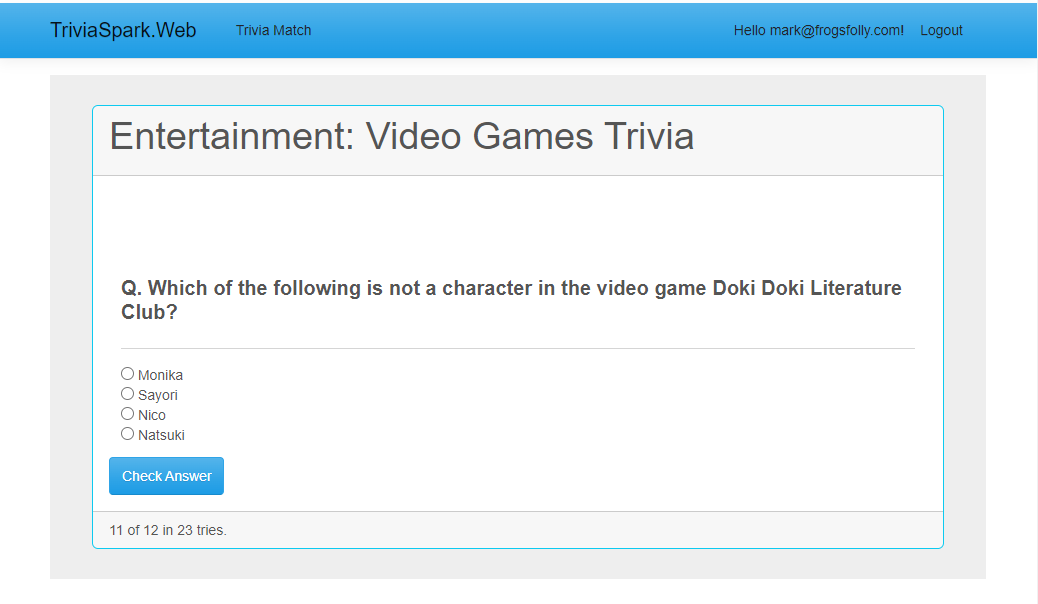
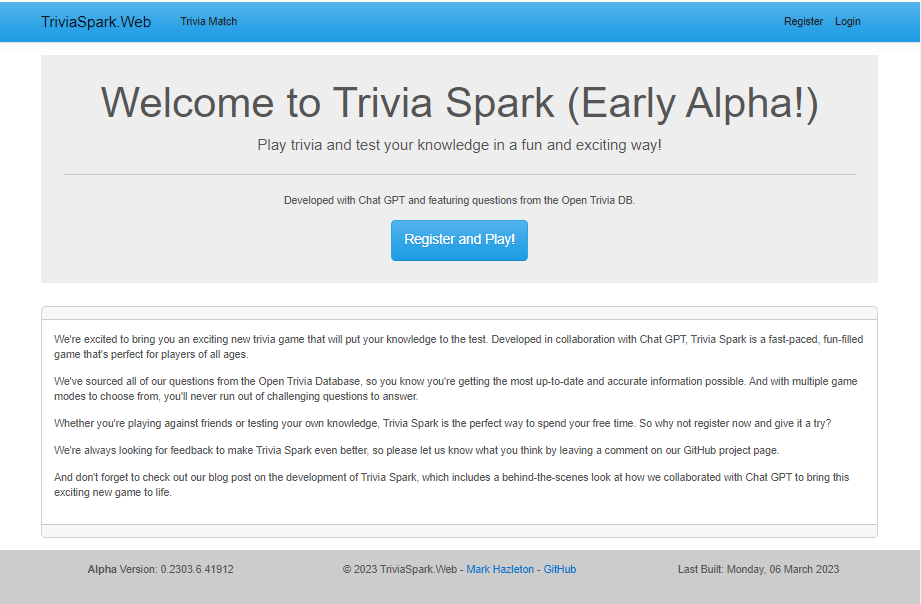
TriviaSpark started as a simple question: what happens when you use ChatGPT as a development partner to build a real application from scratch? The result is a multiplayer trivia game built with .NET that pulls questions from the Open Trivia Database, complete with user registration, leaderboards, and game play modes. More than the application itself, the project became a case study in how AI-assisted development changes the way I approach prototyping and problem solving.
Try it out: TriviaSpark Live Site | GitHub Repository
How the Project Started
The idea for TriviaSpark grew out of my interest in exploring public APIs. The Open Trivia Database offers a free API with thousands of trivia questions across dozens of categories, and it seemed like a natural fit for a quick prototype. What I didn't expect was how much the development process itself would become the story.
Rather than sketching out a full architecture before writing any code, I started a conversation with ChatGPT. I described the goal—a trivia game that could pull questions from a public API, track player scores, and support multiple game modes—and asked for suggestions on how to structure the application. What came back was surprisingly useful: not just boilerplate code, but thoughtful recommendations about data models, API integration patterns, and even UI considerations.
This iterative, conversational approach to development felt different from the way I typically work. Instead of researching documentation and Stack Overflow threads for each decision point, I had a collaborator that could generate options and explain trade-offs in real time.
Collaborating with ChatGPT
The collaboration with ChatGPT went well beyond generating code snippets. Throughout the project, ChatGPT served several roles:
Brainstorming partner. When I was deciding how to represent game modes—should they be simple strings, enums, or a more flexible pattern—ChatGPT walked through the pros and cons of each approach. We settled on using enums backed by a dictionary pattern, which gave flexibility without overcomplicating the data model.
Debugging assistant. When something didn't work as expected, I could paste the error message or describe the behavior and get targeted suggestions. ChatGPT was particularly helpful for catching edge cases I hadn't considered, like handling the API's rate limiting or dealing with HTML-encoded characters in trivia questions.
Architecture advisor. ChatGPT suggested implementing lazy loading for the question model management, which improved performance when loading large trivia sets. It also recommended patterns for separating game logic from UI concerns, which made the codebase easier to test and extend.
Code reviewer. Sharing code with ChatGPT for review surfaced several optimization opportunities. One example: switching from a List-based lookup to a HashSet for tracking answered questions, which improved performance for longer game sessions.
The rapid feedback loop was the real difference-maker. Instead of spending time searching for solutions, I could describe what I wanted, evaluate the suggestion, and iterate. Some suggestions were great out of the box. Others needed refinement. A few were flat-out wrong. But the speed of the feedback cycle more than made up for the occasional miss.
ChatGPT as a Trusted Advisor
One aspect of this collaboration that surprised me was how naturally ChatGPT fell into a trusted advisor role. When I pushed back on a suggestion—"that approach seems overly complex for what we need"—ChatGPT adapted without ego. It offered simpler alternatives and explained why the original suggestion might still be worth considering in a different context.
This dynamic felt productive in a way that's worth examining. A human collaborator might dig in on their recommendation or take the pushback personally. ChatGPT simply reframed and moved forward. That's not to say AI is a better collaborator than a person—it lacks the intuition and contextual judgment that experienced developers bring—but the low-friction iteration was genuinely valuable for rapid prototyping.
Some specific architectural decisions that emerged from these conversations:
- Enum-based game modes with string parsing for flexibility across different trivia categories
- Lazy loading patterns for model management to keep the initial load fast
- Separation of concerns between the trivia data layer (API integration), game logic (scoring, progression), and presentation
- Configurable UI elements that allowed quick experimentation with different layouts for web and mobile
ChatGPT vs. GitHub Copilot
Both ChatGPT and GitHub Copilot played roles in building TriviaSpark, and using them together highlighted their different strengths.
GitHub Copilot excels at the micro-level: completing the line you're writing, suggesting the next method based on context, and auto-generating boilerplate. When I was writing repetitive data access code or implementing standard patterns, Copilot was remarkably efficient. It's at its best when the pattern is clear and the context is immediate.
ChatGPT operates at a higher level of abstraction. It's better suited for architectural discussions, weighing design alternatives, and working through problems that require explanation rather than just code. When I needed to think through how to structure the game state or decide between different API integration strategies, ChatGPT provided the kind of conversational exploration that Copilot isn't designed for.
In practice, I found myself using both tools in a complementary workflow: ChatGPT for planning and problem-solving, Copilot for implementation speed. The combination felt more productive than either tool alone.
The TriviaSpark Application
The application itself has grown from that initial prototype into a more complete trivia platform:
- Multiplayer support with user registration and persistent profiles
- Leaderboards that track performance across game sessions
- Multiple game modes powered by the Open Trivia Database's category system
- Customizable UI that works across web and mobile browsers
- Score tracking with detailed statistics per player and per category
The technical stack is built on .NET, leveraging the framework's strengths for building scalable web applications. The Open Trivia Database API provides the question content, with a caching layer to manage API rate limits and improve responsiveness.
Explore the code: TriviaSpark on GitHub
Lessons Learned
Building TriviaSpark with AI assistance taught me several things worth sharing:
AI tools accelerate the exploration phase. The biggest productivity gain wasn't in writing code faster—it was in exploring design options faster. Getting quick feedback on architectural ideas shortened the time between "what if we tried..." and "here's how that would work."
You still need engineering judgment. Not every suggestion from ChatGPT was correct or appropriate. Understanding when to accept, modify, or reject AI-generated code requires the same critical thinking that any development collaboration demands. The AI is a tool, not a decision-maker.
Rapid prototyping benefits most from AI assistance. The early stages of a project—when you're experimenting with approaches and building the initial structure—are where ChatGPT added the most value. As the codebase matured and the patterns were established, the balance shifted more toward Copilot's contextual code completion.
The tools keep evolving. The AI tools I used during TriviaSpark's initial development have improved significantly since then. The collaboration patterns I developed will undoubtedly shift as these tools gain new capabilities. What remains constant is the need to evaluate tools honestly and integrate them where they genuinely add value.
Parting Thoughts
The kickoff of TriviaSpark was as much about exploring AI-assisted development as it was about building a trivia game. Working with ChatGPT enabled quick prototyping, helped overcome obstacles, and resulted in a working application in a timeframe that would have been difficult to achieve solo.
The collaboration between human developers and AI tools is still in its early chapters. The tools I use are constantly evolving, and I continue to evaluate new ways to integrate them into my development process. What TriviaSpark demonstrated is that the most effective approach isn't to hand off development to AI—it's to develop a productive working relationship where each party contributes what they do best.
If you're curious about AI-assisted development, I'd encourage you to try it on a side project. Start with something small, be honest about what works and what doesn't, and let the experience inform how you integrate these tools into your broader workflow.
Related reading: Using ChatGPT for Developers
Tools and Resources
Here are some of the tools and references that contributed to this project:
- Visual Studio 2022 — Primary IDE for .NET development
- GitHub Copilot — AI-powered code completion
- Open Trivia Database — Free trivia question API
- Stack Overflow — Community-driven Q&A
- .NET Rocks — .NET development podcast
- Shawn Wildermuth – Wilder Minds — .NET and web development insights
- Scott Hanselman — Technology blog and podcast
- Nick Chapsas – Keep Coding — .NET development content